The Short Answer
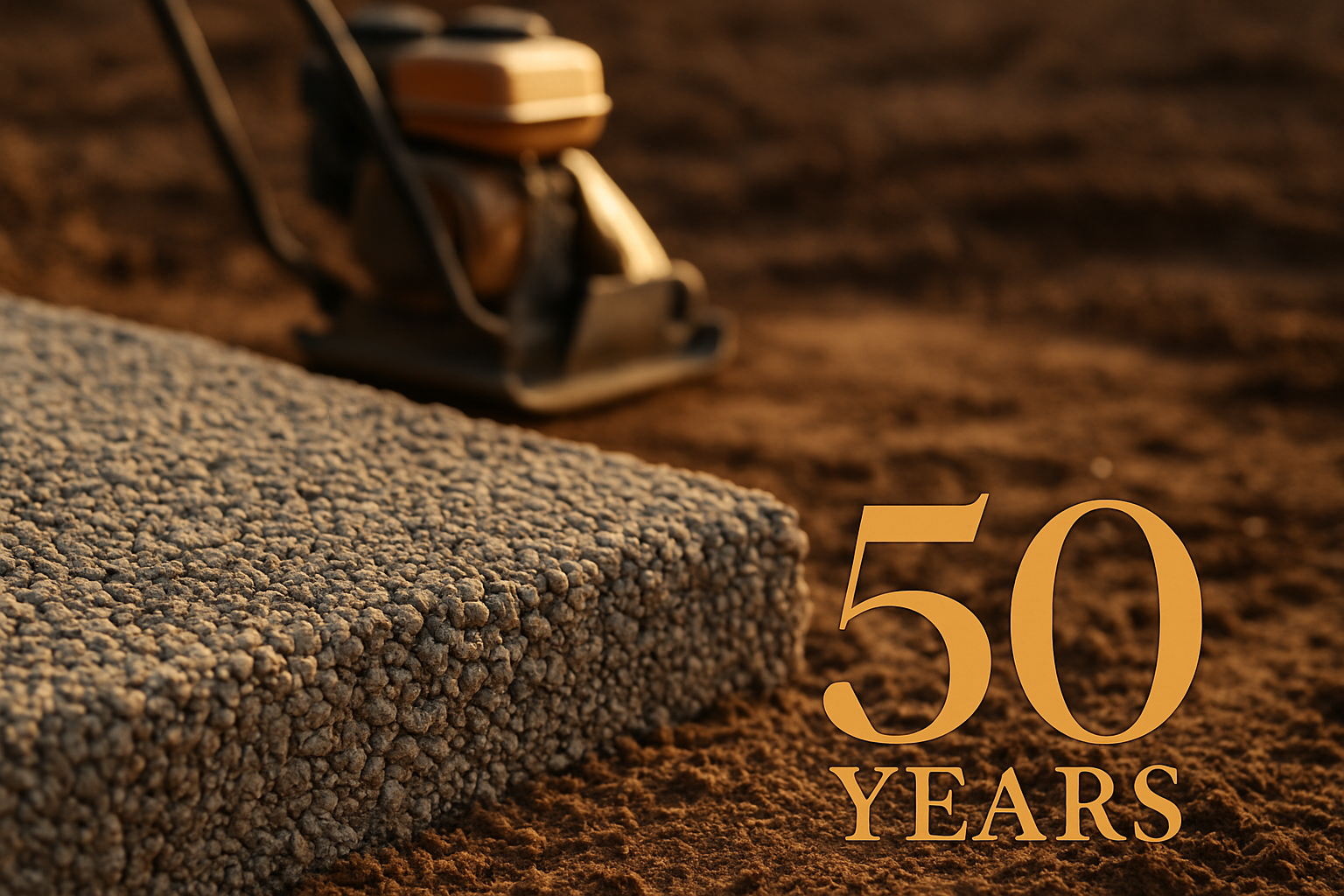
Paver base compaction is the mechanical process of densifying graded aggregate beneath a paver patio into an interlocking load-bearing matrix using a vibratory plate compactor working in 3-inch lifts. Done right — 6–8 inches of Class II road base compacted to 95% Proctor density — it determines whether your paver patio installation lasts 5 years or 50. It's the single most-skipped install detail on low-bid jobs, and the failure it causes is slow enough that most homeowners don't connect the sinking patio to the shortcut until it's far too late to hold anyone accountable.
What Is Paver Base Compaction?
Paver base compaction is the mechanical process of densifying graded aggregate beneath a paver patio into an interlocking load-bearing matrix, using a vibratory plate compactor working in 3-inch lifts.
Here's the physics: loose Class II aggregate has 20–30% void space between particles when first dumped into an excavation. Those voids are air pockets and weak points. A vibratory plate compactor transmits thousands of cycles per minute through the aggregate, forcing particles to reorient, nest, and lock together. After proper compaction, void space drops to 5–10%. The result isn't just denser aggregate — it's a fundamentally different material. Loose aggregate shifts under load. Compacted aggregate transfers load laterally across the entire base matrix and into the subgrade below.
Loose Class II aggregate has 20–30% void space; properly compacted aggregate has 5–10%.
Class II aggregate is a Caltrans-spec graded crushed stone with particles from 3/4 inch down to fines, designed to interlock under compaction. The angular, crushed particle shape is what makes Class II work — angular particles bite against each other when compressed, unlike rounded gravel or sand grains that roll past each other under load. It's the material specified in ICPI Tech Spec 2 (Construction of Interlocking Concrete Pavements), the U.S. standard for interlocking concrete paver installation. ICPI (the Interlocking Concrete Pavement Institute) is the U.S. trade body that sets installation standards for interlocking concrete pavers.
Proctor density is the laboratory-measured maximum dry density of compacted soil, used as the standard for verifying field compaction. The ASTM D698 Standard Proctor compaction test establishes that maximum — and field compaction should reach 95% of it. Below 95%, the base retains enough void space to compress further under repeated load, which is how gradual post-install settlement starts.
For the full install sequence that paver base compaction feeds into, read the full paver patio install walkthrough.
Why Does Paver Base Compaction Matter More Than the Pavers Themselves?
A premium paver on a poorly compacted base will fail in 3–5 years. A budget paver on a properly compacted base will hold for 25 years. The aggregate matrix carries 95% of the load — the pavers ride on top.
The aggregate base carries 95% of a paver patio's load — the pavers ride on top.
Think through the loads a backyard patio actually sees: foot traffic, outdoor furniture, container planters running 300–500 lbs when filled, an occasional appliance being moved across the surface, and on many Lamorinda properties, a grill or outdoor kitchen setup with significant static weight. None of that load dissipates at the paver surface. It transfers downward — through the paver, through the 1-inch bedding sand layer, and into the base aggregate. A properly compacted base distributes that force horizontally across a wide footprint. An under-compacted base concentrates it.
Stress concentration is where early failures originate. When a base can't distribute load evenly, stress concentrates at paver edges and corners — the thinnest, most vulnerable geometry. That's why you see edge chips and corner cracks on patios with weak bases, even when the pavers themselves are structurally sound. The paver didn't fail. The system beneath it did.
Expansive clay is soil that swells when wet and shrinks when dry, with seasonal volume change of 5–10%. Lamorinda Pavers builds paver patios across Lafayette, Orinda, and Moraga where expansive clay makes paver base compaction even more critical than on flat sandy lots. A base that might hold for 8 years on stable sandy soil in Danville fails in 3 years on the clay-heavy lots common in the Orinda hills. The physics don't negotiate.
What Equipment Is Needed to Compact a Paver Base Correctly?
Why a vibratory plate compactor is non-negotiable
A vibratory plate compactor is the only tool that achieves the 95% Proctor density required for a structural paver base. The machine works by transmitting high-frequency vibration through a flat steel plate into the aggregate below, forcing particles to settle and interlock in a way static weight alone can't produce.
Minimum plate-compactor force for paver base work is 3,500 lbs of vibratory output.
Professional-grade machines that meet this spec include the Wacker Neuson WP1550 and the BOMAG BVP 18/45. Both deliver sufficient vibratory force to fully penetrate a 3-inch aggregate lift and compact it from top to bottom. That penetration depth matters — if the compactor's energy doesn't reach the bottom of the lift, the lower half stays under-compacted and becomes a slip plane under load.
Why hand tampers and DIY rentals usually fail
A hand tamper — the manual square plate on a stick — generates roughly 200 lbs of force per strike. That's enough to lightly consolidate bedding sand or tamp a small patch repair. It's two orders of magnitude below what Class II aggregate compaction requires. Pavers installed over a hand-tamped base don't fail slowly; they settle predictably, usually within the first two wet seasons.
DIY rentals are a different trap. Hardware-store rental yards often carry homeowner-grade plate compactors in the 2,000–2,500 lb range. They're marketed as "pro" equipment and look the part. They're not. Running a 2,200 lb compactor over East Bay clay-soil base prep produces under-compaction that reaches 80–85% Proctor density — looks solid on install day, then begins settling three to six months into the first wet season.
A rammer compactor (jumping jack) is also not a substitute. Rammers compact cohesive soils like clay in trench work — their high-impact, narrow footprint is the wrong energy profile for the broad, loose-aggregate base a paver patio requires. Using a jumping jack on Class II aggregate produces uneven compaction with localized peaks and valleys rather than a uniform density field. Plate compactors and rammer compactors are not interchangeable tools.
How Do You Compact a Paver Base — The Actual Technique?
Proper paver base compaction means 6–8 inches of Class II in 3-inch lifts, 4–6 passes per lift in alternating directions, with each lift verified before the next goes in.
Proper paver base compaction requires 6–8 inches of Class II aggregate in 3-inch lifts compacted to 95% Proctor density.
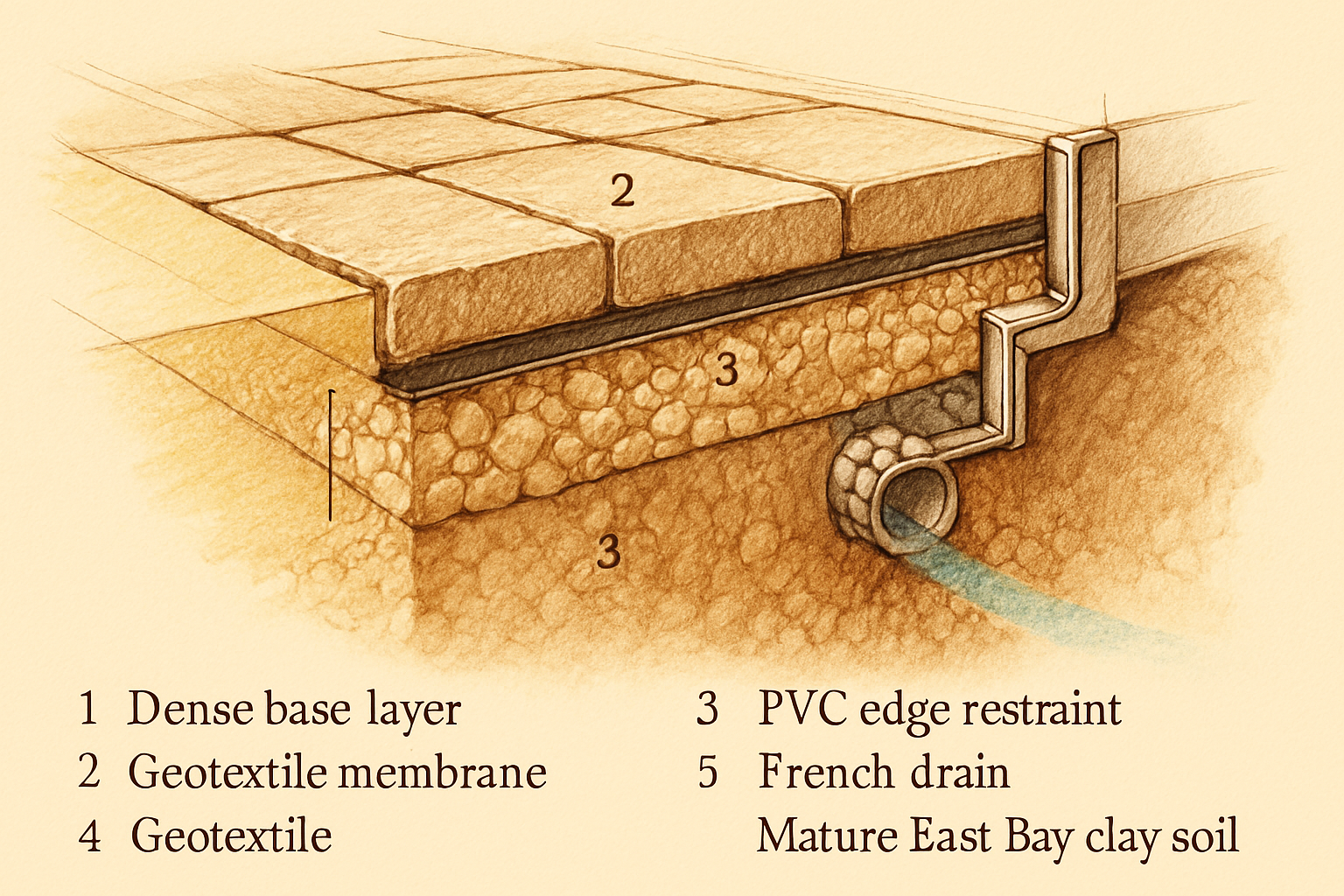
The process in sequence: place 3 inches of Class II aggregate across the geotextile-covered subgrade. Run the plate compactor in 4–6 overlapping passes — north-south first, then east-west, then a diagonal pass if the patio geometry allows it. Alternating directions is non-negotiable: single-direction passes leave compaction shadows (under-compacted strips between the compactor's path lines) that show up as long, linear low spots after install. Repeat for each subsequent lift until you reach 6–8 inches of total compacted depth.
Moisture content matters more than most installers discuss. Slightly damp aggregate compacts best — water acts as a lubricant that lets particles slide into a tighter arrangement under vibration. Bone-dry aggregate compacts poorly because particles bounce against each other rather than locking. Soaking-wet aggregate smears and doesn't compact at all; on East Bay clay-soil subgrades, it also pushes moisture into the subgrade and softens it. The target is aggregate that holds its shape when squeezed but doesn't leave water on your palm.
ICPI Tech Spec 2 (Construction of Interlocking Concrete Pavements) is the reference document governing this process. It specifies base depth by soil type and load category, names Class II aggregate as the correct material for residential paver applications, and establishes 95% Proctor density — measured against ASTM D698 — as the field standard. These aren't preferences; they're the published requirements for a correctly built interlocking paver system.
For context on how this phase connects to grading, bedding sand, and edge restraints, see the full paver patio install walkthrough.
What Does Insufficient Paver Base Compaction Look Like at 2, 5, and 10 Years?
Failure from under-compacted base doesn't announce itself all at once. It develops on a timeline that's predictable once you know what to watch for — and frustrating because each stage is easy to rationalize until repair is unavoidable.
Year 2: Hairline settling appears at patio edges and corners — typically 1/8 to 1/4 inch dips visible when water pools after rain. Joint sand may show slight washout in low spots. Nothing looks catastrophically wrong. Most homeowners assume it's normal settling and move on.
Year 5: Visible joint sand washout spreads across the field. Perimeter pavers have tilted outward by 1/4 to 1/2 inch. Furniture wobbles in fixed spots — chair legs and table bases are sitting on localized low points where load concentration has compressed the base further than the surrounding field. If edge restraints were undersized or spaced too widely, perimeter separation is now obvious.
Year 10: Structural failure. Sections of the patio drop an inch or more. Individual pavers crack at stress-concentrated edges. The base has been contaminated by clay migration from below (if geotextile was skipped) and the aggregate no longer holds density under load. At this point, repair means removing every paver, excavating and replacing the base from subgrade up, and reinstalling. Rebuilding a failed patio in the East Bay market typically runs $18–28 per square foot.
The compounding effect is what makes under-compaction so expensive: once the base fails, you can't correct it without removing everything above it. For guidance on diagnosing how far along failure already is, read the guide on preventing paver patio sinking.
How Can a Homeowner Verify Paver Base Compaction Before Pavers Go Down?
A homeowner can verify paver base compaction with three field tests: the walk test, the hammer ring test, and asking for compaction documentation.
Walk test. Walk the compacted base surface in your normal shoes. There should be zero footprint indent under your full body weight. Any impression — even shallow — means the surface density isn't there yet. Lamorinda Pavers walks every Lafayette paver project, Orinda install, and Walnut Creek install through this verification with the homeowner before pavers go down.
Hammer ring test. Tap the compacted surface with a framing hammer. A properly compacted base rings solid with a sharp, hard sound. An under-compacted base thuds dully. The difference is unmistakable once you've heard both. This is a field method — it doesn't replace density measurement, but it catches obvious failures fast.
Compaction documentation. Ask your contractor whether they Proctor-tested the base material or used a nuclear density gauge on-site. A nuclear density gauge gives a real-time reading of field density against the Proctor maximum. It's uncommon on residential installs but a genuine green flag when a contractor uses one. At minimum, confirm the specific base aggregate is a named Class II material — "gravel" or "crushed rock" without a spec is a yellow flag.
Photograph each lift. Three lifts means three rounds of photos. Ask the crew to notify you when each lift is placed and compacted before the next one starts. Once pavers go down, there's no way to verify what's underneath without pulling them up.
These verification steps aren't adversarial — they're the same due diligence you'd apply to any significant home project. A contractor who objects to them is telling you something. Browse completed Lamorinda paver projects to see documented installs where these steps were applied on every job.
Common Shortcuts That Destroy Paver Base Compaction
Each of these failure modes produces predictable damage on a timeline your contractor won't mention when they hand you the low bid.
Placing more than 3 inches of aggregate per lift. A vibratory plate compactor's energy penetrates 3–4 inches into aggregate. Dump 6 inches at once and only the top half compacts; the lower half stays loose and settles after install. It's the most common shortcut because it cuts Day 2 work nearly in half.
Using a hand tamper or jumping jack instead of a plate compactor. Wrong tool, wrong density profile. A rammer compactor is built for compacting cohesive soil in trenches — not for creating a uniform density field in granular aggregate. Hand tampers don't generate anywhere near the 3,500 lbs of vibratory force the spec requires.
Compacting over wet clay subgrade. Clay subgrade needs to be dry enough to hold its shape under compaction. Wet clay smears and creates a slick plane between subgrade and base aggregate — a slip plane that becomes a failure surface the first time winter rain re-saturates it. If rain interrupts excavation on a Moraga or Lafayette clay-soil lot, the correct move is to wait.
Skipping geotextile fabric. Non-woven geotextile fabric between subgrade and base aggregate prevents clay fines from migrating upward into the aggregate — a process called subgrade contamination. Without it, 2–5 wet seasons slowly clog the aggregate's drainage capacity and reduce base density from below. By the time the surface shows movement, the base is already compromised.
Using decomposed granite or crushed miscellaneous base as aggregate. Decomposed granite is a landscaping material with a particle shape and grading curve that doesn't interlock under compaction the way Class II does. It softens when wet, loses density, and fails to distribute load across the base matrix. Class II aggregate costs roughly $1.50–2.50 per square foot more in material. Rebuilding a DG-based patio after two to three seasons costs far more.
These failure modes aren't hypothetical — they're what drives the repair calls. The guide on preventing paver patio sinking walks through how each one presents at the surface level and what a correct diagnosis looks like.
Frequently Asked Questions
What is paver base compaction?
Paver base compaction is the mechanical process of densifying graded aggregate beneath a paver patio into an interlocking load-bearing matrix using a vibratory plate compactor working in 3-inch lifts. It converts loose aggregate — which has 20–30% void space and shifts under load — into a rigid foundation with 5–10% void space that transfers traffic loads evenly into the subgrade. It's the phase of paver patio installation that determines whether the surface holds level for 25 years or begins settling within two to three seasons.
How deep should paver base compaction be?
In East Bay clay soil — Lafayette, Moraga, Orinda, Walnut Creek, and surrounding Contra Costa lots — the correct compacted base depth is 6–8 inches of Class II aggregate, installed in 3-inch lifts. That spec aligns with ICPI Tech Spec 2 guidelines for expansive-soil conditions and ASTM D698 Proctor density standards. The 4-inch minimum in general paver specifications applies to stable, well-draining soil. East Bay clay doesn't qualify.
Can you compact paver base by hand?
No. A hand tamper generates roughly 200 lbs of force per strike — far below the 3,500 lbs minimum vibratory output required to compact Class II aggregate to 95% Proctor density. Hand-tamped base achieves 70–80% density at best, which looks fine at installation and settles progressively under load. On an Orinda or Moraga clay-soil lot, hand-tamped base typically shows visible failure within two wet seasons.
What does properly compacted paver base feel like?
A properly compacted paver base feels completely rigid underfoot — no give, no footprint indent, no flex when you shift your weight. Walk the surface in normal shoes: any impression, even shallow, means the base isn't ready. Tap it with a framing hammer: it should ring sharp and solid, not thud dully. Both field tests can be run by a homeowner before pavers go down.
How long does paver base compaction take?
For a standard residential patio in the East Bay — 300 to 600 square feet — paver base compaction takes one full day. That covers placing and compacting two to three lifts of Class II aggregate at 3 inches each, with 4–6 plate-compactor passes per lift in alternating directions. If a contractor quotes a one-day total install on a clay-soil lot, they're not doing the base work correctly.
What happens if a paver base isn't compacted enough?
Under-compacted base settles after install on a predictable timeline. By year two, minor edge dipping and water pooling appear. By year five, joint sand washes out, perimeter pavers tilt, and furniture wobbles on localized low spots. By year ten, sections drop an inch or more, pavers crack at stressed edges, and full removal and rebuild is the only fix — typically running $18–28 per square foot in the East Bay market.
Want the Full Install Context? Read the Hub Posts
Paver base compaction is one phase of a four-day paver patio installation — and one failure mode out of several. For the complete drainage, grading, bedding sand, edge restraint, and polymeric sand picture, read the full paver patio install walkthrough. If you're dealing with an existing patio that's already showing settlement signs, the guide on preventing paver patio sinking walks through how to diagnose which system failed and whether repair or rebuild is the right call.
Start with the Phase That Matters Most
If you're planning a paver patio and want a contractor who treats paver base compaction as the install's most important phase — not the fastest one to finish — request a free on-site estimate from Lamorinda Pavers. We'll walk the property, assess soil conditions, and run a Proctor test on the subgrade if conditions warrant it. Within 48 hours, you'll have a fixed-price proposal that names the base depth, lift count, compaction spec, aggregate product, and 5-year workmanship warranty terms in writing — before you commit to anything.
Lamorinda Pavers builds paver patios across Lafayette, Orinda, Moraga, Walnut Creek, and Danville — on the expansive-clay lots where base compaction isn't a formality. It's what determines whether the patio you invest in this spring still looks right five winters from now. Browse completed Lamorinda paver projects to see documented installs, or contact us to schedule your estimate.