10 Outdoor Living Build Coordination Bottlenecks (and How to Prevent Them)
The Short Answer
Outdoor living project delays in the East Bay happen for 10 specific reasons: incomplete plans at permit submittal, failed inspections, subcontractor scheduling conflicts, GC overbooking, premium material backorders, custom stone fabrication and appliance lead-time delays, missed weather windows, hidden subgrade conditions, homeowner indecision on key specs, and HOA architectural review delays. Each bottleneck adds 1–4 weeks. A 12-week outdoor living project becomes a 22-week project when three or more bottlenecks hit consecutively. None of them are bad luck — every one has a preventable cause and a practice that stops it before it starts.
Why Do Outdoor Living Projects Get Delayed? (The Five Dimensions to Manage)
Outdoor living coordination breaks down across five dimensions: permits and inspections, subcontractor scheduling, material procurement, weather and site conditions, and stakeholder communication. The 10 most common bottlenecks all map back to one of these five.
The difference between a project that finishes in June — in time for summer entertaining — and one that limps into October is almost never construction quality. It's coordination failure at one or more of these seams. Getting your outdoor living and paver patio installation right means understanding each failure mode before your project starts, not after it slips.
The bottlenecks below cover the specific failure modes: what causes each one, what it costs in time and money, and how to prevent it. For the positive framing — the full coordination process structured to keep these bottlenecks from triggering in the first place — see the coordination process framework. This post covers what goes wrong and why.
Bottleneck 1: Incomplete Plans at Permit Submittal
Permits stall before they're issued when plans submitted to the jurisdiction don't include all required details — gas line sizing, electrical load calculation, fire feature setbacks, structural plans for pergolas above local height thresholds. This is one of the most preventable outdoor living project delays on the list, and one of the most common.
Why it happens. Some GCs submit incomplete packages deliberately to start the review clock, expecting to amend during review. Jurisdictions in Lafayette, Orinda, Walnut Creek, Moraga, and Danville don't accept mid-review amendments without restarting the queue. What looks like a shortcut adds weeks.
Time and cost impact. Each incomplete submittal adds 1–3 weeks of delay per round-trip correction in East Bay jurisdictions. Combined gas, electrical, and building permit review typically runs 2–4 weeks from a complete submittal — that window stretches to 5–7 weeks when the jurisdiction sends it back for revisions.
How to prevent it. Before submitting, your GC should review the jurisdiction's specific checklist directly with the permit counter — not interpret it from memory. The checklist varies meaningfully between Lafayette, Orinda, and unincorporated Contra Costa County. Ask to see the full submittal package before it goes in. If the GC can't produce it, that's an answer.
What a good GC does. Coordinates a pre-submittal meeting or call with the permit counter, confirms every required exhibit is included, and submits once — complete. Permit pull responsibility is written into the contract, not implied. For a checklist of what to ask during the hiring process, see vetting outdoor kitchen and fire pit contractors.
Bottleneck 2: Failed Inspection Requiring Rework and Reschedule
A failed inspection on an East Bay outdoor living project costs 1–2 weeks for rework and reschedule. The most common failures: gas line pressure tests, electrical rough-in GFCI verification, and fire feature setback compliance.
NFPA 58 is the U.S. liquefied petroleum gas code governing outdoor fire feature fuel storage, line sizing, and appliance setbacks — and it's the most common failure source for fire feature inspections in Lafayette, Orinda, and Walnut Creek. Many subs who've worked primarily on indoor gas runs aren't current on NFPA 58 compliance for outdoor fire feature configurations. That gap shows up at inspection.
Why it happens. Rushed rough-in work, a sub who hasn't pulled a permit in this specific jurisdiction recently, or an inspector who catches a deviation the crew didn't flag. Inspectors in Lafayette, Orinda, and Walnut Creek typically have 3–5 business day scheduling windows for re-inspection — so a single failed inspection rarely costs less than a week, even when the correction itself takes hours.
Time and cost impact. 1–2 weeks per failed inspection for rework plus re-inspection scheduling. A project with two failed inspections at different phases has lost a month.
How to prevent it. Use experienced subs who've passed similar inspections in your specific jurisdiction recently. Before the official inspection, have the GC walk the rough-in with the sub and check against the submitted plans — not against memory of what was built. Confirm the fire feature location was derived from current local fire authority distance rules under NFPA 58, not approximated from a prior project.
What a good GC does. Treats a failed inspection as a same-day priority — identifies the correction, schedules re-inspection the same week, and communicates both to the homeowner in writing within 24 hours. Waiting until the next weekly check-in to raise a failed inspection is how one week becomes three. For more on fire feature permitting specifically, see custom fire pits and fire features.
Bottleneck 3: Trade Subcontractor Scheduling Conflict
Trade subcontractor scheduling conflicts — gas, electrical, plumbing, or stone fabrication — stall outdoor living projects 1–3 weeks when a sub is booked on another job during your scheduled window. This is one of the most under-discussed sources of outdoor living project delays, because it's invisible until it happens.
Why it happens. Trade subs are independent businesses. They're not waiting for your project. A C-36 gas contractor working across the East Bay has half a dozen GC relationships and books against all of them. If your GC hasn't confirmed a hard date with a written commitment 2–4 weeks in advance, "available that week" is not a real reservation.
Time and cost impact. 1–3 weeks of direct delay per scheduling conflict. When the delayed trade sits in the middle of a sequence — gas trench before aggregate, electrical before appliance install — the phase after it can't start until it finishes. One sub conflict can cascade across two or three subsequent phases.
How to prevent it. Your GC should book every trade sub against confirmed dates, not availability windows. That means written sub commitments with specific start dates, not verbal agreements to show up "when the hardscape is done." Ask during the bid conversation: how far in advance do you book your subs, and do you have a written commitment for each trade on this project?
What a good GC does. Maintains 2–3 working relationships per trade so a backstop is available when a primary sub has a conflict. A GC with one gas contractor and one electrical contractor has no flexibility — your project absorbs every scheduling problem those subs have. Contractor and subcontractor management is a system, not a favor economy.
Bottleneck 4: GC Overbooked Across Too Many Concurrent Projects
Outdoor living GCs running five or more concurrent projects often can't give any single project the on-site attention coordination requires — and your project becomes the one that slips when another homeowner escalates.
Why it happens. Outdoor living construction is seasonal in California. Spring and summer are peak demand. GCs over-stack schedules to capture revenue during the build window, which means site visits become weekly check-ins, and weekly check-ins become bi-weekly when anything slips. The GC who was attentive during bidding becomes hard to reach by week four.
Time and cost impact. GC overbooking typically produces 2–4 weeks of cumulative slippage across the project lifecycle — not a single delay event, but a slow drift where every phase finishes 2–3 days late and nothing ever catches up.
How to prevent it. During the bid conversation, ask directly: how many active concurrent projects are you running right now, and how many will be active during my build window? Ask who specifically is on your site each week — a named person, not "one of our crew." Ask whether the owner is on-site during base inspection and final punch-list or delegates those to a project manager.
What a good GC does. Limits concurrent projects to a number the team can genuinely cover. How Steve runs Lamorinda Pavers reflects this directly: Lamorinda Pavers is owner-operated by Steve Barsanti and intentionally limits concurrent projects across Lafayette, Orinda, Moraga, Walnut Creek, and Danville so each homeowner gets owner-level attention — not a hand-off to a coordinator who wasn't at the design walk.
Bottleneck 5: Premium Paver or Specialty Material Backorder
Premium paver backorders run 4–12 weeks at peak demand. Belgard Mega-Arbel, Calstone Stonehedge, and Techo-Bloc imports are consistently the longest-lead SKUs — regional distributors don't hold meaningful inventory on specialty formats and colors.
Why it happens. Regional paver inventory shifts seasonally. Specialty colors and formats aren't stocked at distributor yards the way standard grays and tans are. A paver selected from a showroom sample may carry a 6–8 week lead time the showroom rep didn't mention. Projects that lock design without confirming inventory availability discover the backorder at the moment material should be arriving on site.
Time and cost impact. 2–8 weeks of pure delay, with no meaningful cost impact beyond the schedule hit — but a 6-week paver delay on a project with subs booked against specific dates means rescheduling every trade lined up behind it. Material procurement and lead times deserve the same attention as the construction schedule itself.
How to prevent it. Confirm paver availability with the distributor at design lockdown, before contract signing if possible. Identify a substitute paver — same pattern, available colorway — during the design process so a switch is a one-day decision rather than a two-week restart. Ask your GC specifically: have you confirmed inventory on this SKU with the distributor?
What a good GC does. Places the material order within days of design lockdown — not after permits clear — and presents substitution options at order time, not at backorder notification. A GC who waits until the original estimated delivery date to discover a backorder wasn't tracking the order.
Bottleneck 6: Custom Stone Fabrication or Appliance Lead-Time Delay
Custom counter stone fabrication for outdoor kitchens runs 4–8 weeks template-to-delivery. Premium grills and appliances from Lynx, Hestan, and DCS run 2–6 weeks depending on SKU and regional distributor inventory. Louvered aluminum pergola systems from StruXure or Renson run 6–10 weeks manufactured to order. When any of these slip 1–2 weeks past forecast, the trade scheduled after them stalls.
Why it happens. Stone fabrication and pergola manufacturing are made-to-order — there's no inventory buffer. Appliance distributors carry core SKUs but not every configuration. A 48-inch built-in grill in a non-stock finish adds lead time that wasn't visible at the showroom. Project scheduling and sequencing falls apart when made-to-order items aren't ordered early enough to absorb slippage.
Time and cost impact. 1–4 weeks of cascading delay per late material arrival. The counter fabricator can't template until the kitchen base is complete; the appliance installer can't commission until the counter is set. A two-week stone delay moves two subsequent trades by two weeks each. For a full picture of what a well-sequenced outdoor kitchen scope looks like, see custom outdoor kitchens.
How to prevent it. Order all made-to-order materials at design lockdown — not at contract signing, not at permit approval. Track lead times weekly during the procurement phase rather than assuming the original estimate was accurate. Pre-identify substitutions for any item with a known lead time over four weeks.
What a good GC does. Builds a material procurement schedule with specific order dates and expected delivery windows, shares it with the homeowner, and updates it weekly. A GC who doesn't have a procurement schedule isn't tracking deliveries — which means the first signal of a delay is a missed arrival date, not a proactive update.
Bottleneck 7: Weather Window Missed on Base Prep or Polymeric Sand
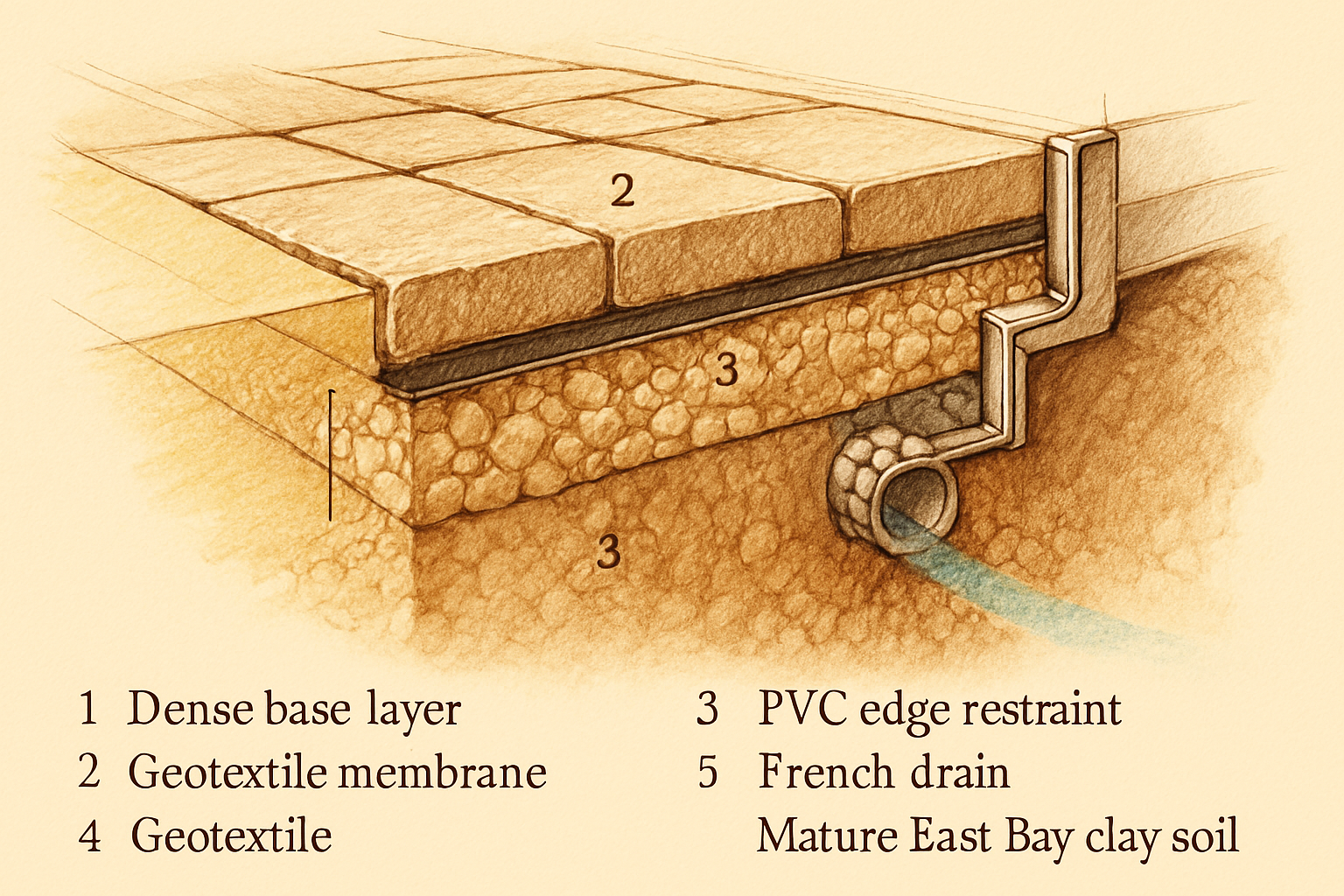
East Bay winter rain shuts down base compaction — saturated clay subgrade won't compact to ICPI (Interlocking Concrete Pavement Institute) standards for moisture content — and ambient temperatures above 80°F accelerate Techniseal HP NextGel polymeric sand cure beyond the recommended application window. ICPI base compaction moisture content guidance specifies the soil conditions required for proper lift compaction; a GC who proceeds on wet clay is building a base that will fail. Missing either weather condition stalls the affected phase 1–3 weeks waiting for the next viable window.
Why it happens. The shoulder seasons — October through November and April through May — are particularly unpredictable in the Lamorinda hills and Walnut Creek corridor. A base compaction phase planned for a dry week in late October can hit a ten-day rain window that turns the excavated footprint into standing water. Summer heat above 80°F is nearly guaranteed in Danville and Walnut Creek by mid-July.
Time and cost impact. 1–3 weeks per missed weather window. Two weather delays on a single project add 2–6 weeks. On a project planned to finish in September, a late-summer rain delay followed by a heat delay on Techniseal HP NextGel polymeric sand application can push completion into November.
How to prevent it. Schedule base prep and polymeric sand application with NOAA forecast data, not optimism about the calendar. Build a 7-day buffer around each weather-sensitive phase — base compaction and polymeric jointing — so a single bad week doesn't cascade. For more on what proper base construction looks like, see paver base compaction and why it matters.
What a good GC does. Monitors the 10-day forecast for every weather-sensitive phase and communicates schedule adjustments proactively — not after a phase was attempted and failed. Weather-sensitive phases are known before the project starts; a good GC builds buffer time into the schedule from day one rather than hoping for favorable conditions.
Bottleneck 8: Hidden Subgrade Discovery During Excavation
Hidden subgrade discoveries surface on roughly 30–40% of East Bay residential outdoor living projects. Old concrete slabs, buried irrigation laterals, abandoned drainage tile, or expansive clay wetter than the pre-construction assessment predicted — each one stops the project for remediation and change-order negotiation.
Expansive clay is soil that swells when wet and shrinks when dry, with seasonal volume change of 5–10% — it's the dominant subgrade condition in Lafayette, Orinda, Moraga, and the Walnut Creek foothills, and it frequently presents wetter than surface inspection suggests.
Why it happens. Most East Bay residential lots in Lafayette, Walnut Creek, and Orinda have 20–40 years of buried infrastructure: irrigation systems from prior landscaping phases, drainage trenches from old downspout runs, concrete pads under old landscaping. None of it appears on drawings. The excavator finds it.
Time and cost impact. 1–3 weeks for remediation plus change-order processing, plus 5–15% cost increase on the affected phase. An old concrete slab under a Walnut Creek patio footprint requires breaking, hauling, and re-grading — that's a week of work that wasn't in the original schedule or bid.
How to prevent it. A 10–15% contingency line in the original contract specifically for buried conditions is the baseline. Ask your GC directly what they include in contingency and how buried conditions are handled in the change-order process. For more on building this contingency correctly, see budgeting for change-order contingency. Also see how to prevent paver patio sinking for context on why subgrade prep determines long-term stability.
What a good GC does. Documents the find with site photos immediately, stops the affected work, provides a written change-order estimate within 24 hours, and resumes only after the homeowner signs. No verbal approvals; no proceeding on an assumption that it'll be sorted out later.
Bottleneck 9: Homeowner Indecision on a Key Spec Mid-Project
Outdoor living projects stall 1–3 weeks when homeowners delay decisions on key specs — paver color and pattern, kitchen counter material, fire feature size, pergola style — past the deadlines the build sequence requires. This bottleneck is one of the only ones where the homeowner is the direct cause — which also means it's entirely within your control to prevent.
Why it happens. Decisions that looked resolved during design look different when samples are on-site and the footprint is excavated. Partner alignment takes longer than expected. A paver color that seemed right in the showroom looks different against the house stucco in direct afternoon sun. The indecision is reasonable; the timing is expensive.
Time and cost impact. 1–3 weeks per indecision event. When a delayed decision blocks a material order, the lead-time clock doesn't start until the decision is made — so a two-day delay in confirming a counter material adds two days plus the full fabrication lead time. For a full list of what decisions gate which phases, see 12 features full-service paver patios should include.
How to prevent it. Lock all major specs before construction starts — with a written design-lockdown date in the contract. Every spec that can delay procurement has a deadline: paver selection, counter material, appliance configuration, pergola system. Those deadlines should appear as named calendar dates in the project schedule, not as "before we get to this phase."
What a good GC does. Provides a decision calendar at project kickoff — a list of every homeowner decision required, with the date by which it's needed and what it gates. When a homeowner misses a deadline, the GC raises it the same day, not at the next weekly check-in.
Bottleneck 10: HOA Architectural Review Delays
An HOA architectural review committee is a homeowner association body that reviews proposed exterior modifications to ensure compliance with neighborhood design guidelines before construction may proceed. In Lafayette, Orinda, and Moraga estate communities — Orinda Downs, Wilder, Orindawoods, and Lafayette's Burton Valley, among others — HOA architectural review committees can take 3–8 weeks to approve outdoor living plans, often longer than the city permit timeline.
East Bay HOA architectural review committees take 3–8 weeks for outdoor living approval — often longer than the city permit. Many committees meet monthly, not weekly. A submittal that misses the monthly meeting date by one day waits 30 days for the next review cycle. Unlike city permit delays, HOA delays can't be expedited — there's no fee to pay for faster review.
Why it happens. HOA review processes run on the committee's calendar, not the homeowner's project schedule. A project that submits plans to the city but overlooks the HOA submittal discovers the gap when construction is ready to start — and then waits two or three monthly meetings for approval. This is among the most common pre-construction outdoor living project delays in Orinda and Lafayette estate communities.
Time and cost impact. 3–8 weeks of pre-construction delay when HOA approval is required and wasn't started at the right time. Permit and inspection coordination must include the HOA timeline — treating it as a secondary step is what causes the delay.
How to prevent it. Identify the HOA approval requirement during the design phase, before permit submittal. Submit to the HOA in parallel with the city permit submittal, not after city approval comes through. Build the HOA timeline into the project schedule from day one. A project with a 4-week HOA review cycle and a 3-week city permit review should have both submittals go in the same week.
What a good GC does. Asks about HOA membership at the first site visit, confirms the review process and meeting cadence with the HOA management company directly, and submits HOA documents the same week as city permits. Treating HOA review as a secondary step behind city permits is the single most consistent cause of pre-construction delays on estate community projects in Orinda and Lafayette.
How to Build Coordination Resilience Into Your Project From Day 1
Outdoor living projects that finish on schedule build resilience into their plan from day 1 with five practices: design lockdown before construction, written sub commitments, weather-buffered scheduling, buried-condition contingency, and HOA timeline parallelism.
Design lockdown before construction. Every material spec, appliance selection, and paver pattern is confirmed before excavation starts. No "we'll decide that later" items with procurement lead times.
Written sub commitments. Every trade — gas, electrical, stone fabrication — has a confirmed start date in writing, not a verbal understanding. The GC maintains backup sub relationships so a schedule conflict doesn't become a project stoppage.
Weather-buffered scheduling. Base compaction and polymeric sand application phases have 7-day buffers built into the schedule. Weather-sensitive phases aren't scheduled to the edge of the forecast.
Buried-condition contingency. A 10–15% contingency line in the contract, a written change-order process triggered within 24 hours of discovery, and a GC who stops work rather than proceeding on verbal assumptions.
HOA timeline parallelism. HOA architectural review submittal goes in the same week as city permits. The HOA meeting calendar is on the project schedule from day one.
Lamorinda Pavers builds outdoor living projects across Lafayette, Orinda, Moraga, Walnut Creek, and Danville with all five resilience practices built into the contract before work starts. Every project is covered under a 5-year workmanship warranty on the complete integrated scope — drainage failure, base settlement, edge restraint movement, joint sand failure, and hardscape-to-structure tie-in failure attributable to installation defect. Want to see how the full sequencing works before any of these bottlenecks can take hold? The positive-framing resource for that is the coordination process framework. For questions to ask any GC before signing, see 9 questions to vet a paver installer for big patios.
Frequently Asked Questions
Why is my outdoor living project delayed?
Outdoor living project delays in the East Bay trace back to 10 specific bottlenecks: incomplete permit submittals, failed inspections, trade sub scheduling conflicts, GC overbooking, premium paver backorders, custom stone or appliance lead-time slippage, missed weather windows on base prep or polymeric sand, hidden subgrade discoveries, homeowner indecision on key specs, and HOA architectural review delays. Each adds 1–4 weeks; three or more hitting consecutively is how a 12-week project becomes a 22-week project. Every one has a preventable cause — none are unavoidable with the right coordination structure in place from day one.
How do I get my hardscape project back on schedule?
Getting a delayed hardscape project back on schedule starts with identifying which bottleneck caused the slip. Failed inspection? Schedule re-inspection the same week. Sub scheduling conflict? The GC needs to activate a backup relationship immediately. Material backorder? Confirm the updated delivery date directly from the distributor, identify a substitute, and decide within 48 hours. The common thread: every recovery requires same-day escalation. If your GC isn't escalating delays that day, the coordination gap is part of the problem — not just the original bottleneck.
What's the most common reason outdoor remodels go over budget?
Three categories drive most outdoor living budget overruns: buried subgrade conditions (add 5–15% to the affected phase), mid-build scope additions (add 10–30% over original bid pricing on the same item), and material upgrade decisions made after templates are cut (add 5–15%). The fix for all three is front-loading: a 10–15% contingency in the original contract, every potential feature priced as an original-scope alternate, and all material selections confirmed before design lockdown. For a full line-item framework, see budgeting for change-order contingency.
How long does HOA approval take in Lafayette or Orinda?
HOA architectural review committees in Lafayette and Orinda communities — Orinda Downs, Wilder, Orindawoods, Burton Valley — typically take 3–8 weeks for outdoor living plan approval. Many committees meet monthly, so a submittal that misses the meeting date by a single day waits 30 days for the next cycle. Submit to your HOA the same week as your city permit submittal — not after city approval comes through. If you don't know your HOA's review cadence, call their management company before any permits go in.
What permits delay outdoor kitchen installation?
Three permit types delay outdoor kitchen installation in Lafayette, Orinda, Moraga, Walnut Creek, and Danville: gas permits for any new gas appliance run, electrical permits for new circuits and GFCI outlets, and building permits when the kitchen structure exceeds local height thresholds or qualifies as a permanent structure under local zoning. Combined review typically runs 2–4 weeks from a complete submittal; incomplete submittals add 1–3 weeks per correction cycle. The permit window should run concurrently with material procurement — not sequentially. For more on multi-trade permit coordination, see vetting outdoor kitchen and fire pit contractors.
How do I prevent material backorders on a hardscape project?
Confirm paver and specialty material availability with the distributor at design lockdown — not at contract signing, not after permits clear. For premium SKUs like Belgard Mega-Arbel, Calstone Stonehedge, and Techo-Bloc imports, ask your GC which distributor carries the material and what the current lead time is. Identify a substitute material — same pattern, available colorway — during the design process so a backorder is a fast decision rather than a two-week restart. Track lead times weekly during the procurement phase; the original estimate isn't always accurate and nobody will call you if it slips.
Plan Your East Bay Outdoor Living Project Without the Bottlenecks
If you want to avoid all 10 outdoor living project delays on your East Bay build, start with a free on-site estimate from Lamorinda Pavers. We'll walk the property, scope the build, and share the coordination plan in writing — weather-buffered scheduling, written sub commitments, buried-condition contingency, HOA-timeline parallelism, and weekly check-ins — before you sign anything.
A fixed-price proposal lands within 48 hours of the site visit. Every trade is line-itemed. Permit pull responsibility is named in writing. Material order dates are on the schedule. The 5-year workmanship warranty covers the integrated build — drainage, base, edge restraints, joint sand, and hardscape-to-structure tie-ins — not just the paver field.
Across Lafayette, Orinda, Moraga, Walnut Creek, and Danville, this is how outdoor living and paver patio installation projects finish on time, on budget, and on scope. Contact us to schedule your site visit.