10 Ways Pro Paver Installation Improves Outdoor Living
The Short Answer
The benefits of professional paver installation are concrete and measurable — not marketing claims. Professional installation delivers 10 specific upgrades over amateur or cut-rate work: a 25–50 year lifespan instead of 5–15 years, vehicle-load capacity on driveways, level tolerance under 1/4 inch over 8 feet on patios, East Bay clay-soil resilience, integrated drainage, modular repairability without full surface replacement, code compliance for permits and stormwater, 60–85% resale recovery, material continuity across the outdoor hardscape, and a transferable workmanship warranty that buyers' inspectors verify. Each one is measurable — in contract language, in inspection results, and in the performance of your installation across 10 or 20 East Bay wet seasons.
Why These 10 Improvements Matter for East Bay Homes Specifically
East Bay paver projects face three regional conditions that amplify the importance of professional installation — expansive clay subgrades that move 2–4 inches seasonally, hillside topography that concentrates winter rainfall on hardscape, and luxury market price thresholds where outdoor living quality affects resale recovery by 60–85%.
These three conditions don't exist in flat sandy markets where amateur paver installs sometimes hold up for a decade before showing problems. Lafayette, Orinda, Moraga, Walnut Creek, and Danville lots all combine all three. A patio on a Moraga hillside sits over Orinda Formation clay that swells and shrinks with the rains, collects runoff from uphill grade, and shows in every listing photo at the price point where buyers pay close attention to quality.
That combination is why the 10 improvements below aren't generic contractor talking points — they're engineering responses to specific local conditions. For the full technical framework behind what professional paver installation requires on East Bay clay-soil lots, the professional paver installation category guide covers every build dimension in depth.
One note on scope: on flat lots with sandy, well-draining soil and minimal vehicle load, small DIY patio installs can hold up. That profile describes very few East Bay residential lots. The 10 improvements below are calibrated to the conditions that actually exist here.
Improvement 1: 25–50 Year Lifespan vs. 5–15 Years for Amateur Installs
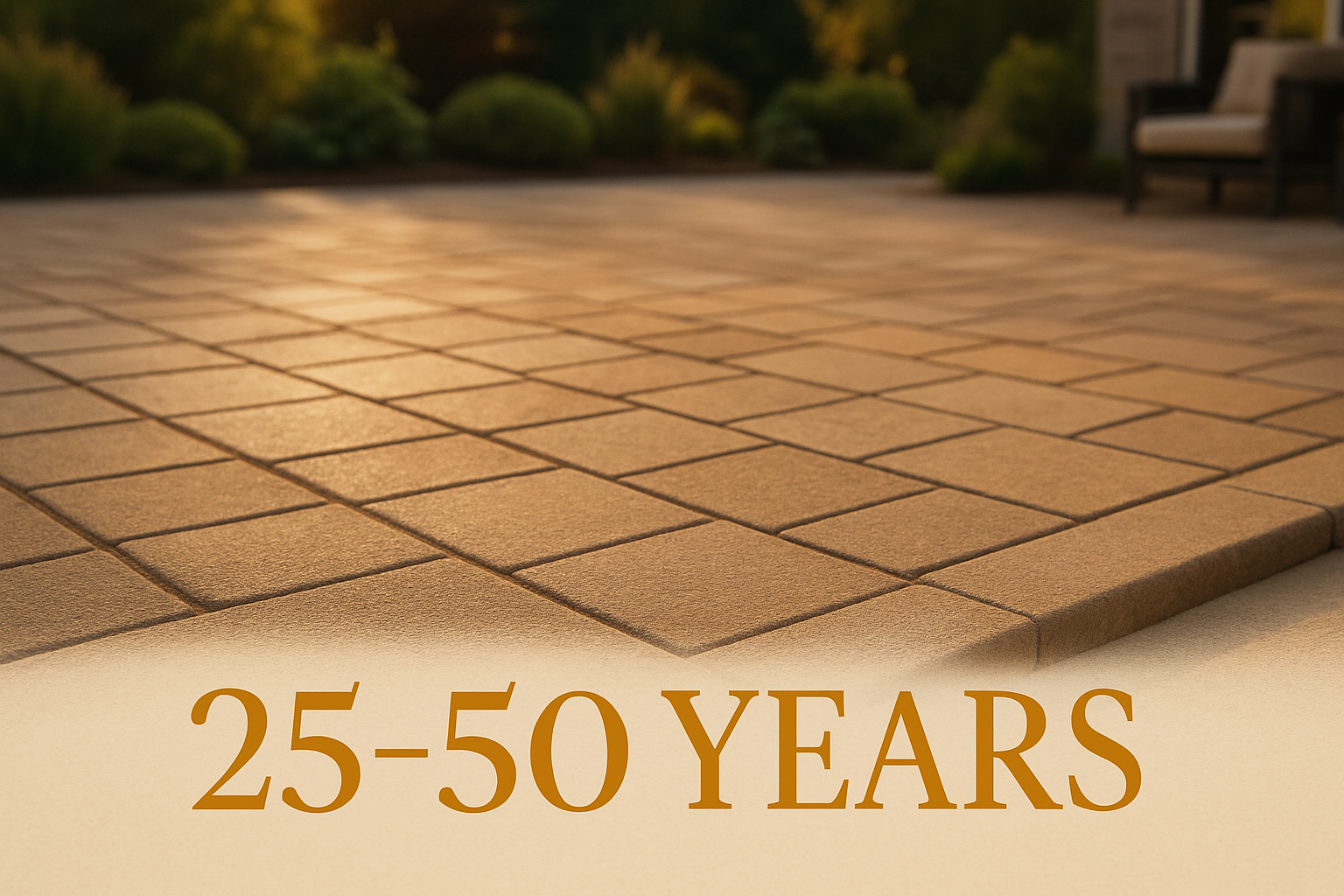
Professional paver installation lasts 25–50 years on East Bay clay-soil lots — three to five times longer than amateur installs that typically show visible failure within 5–15 years.
The lifespan difference comes entirely from what's underneath the pavers, not the pavers themselves. ICPI (the Interlocking Concrete Pavement Institute) is the U.S. trade body that sets installation standards for interlocking concrete pavers. Their ICPI Tech Spec 2 (Construction of Interlocking Concrete Pavements) specifies 8–10 inches of compacted Class II aggregate built in 3-inch lifts to 95% Proctor density — with a non-woven geotextile fabric separating the base from the native clay subgrade to prevent fines migration over time. Amateur installs commonly use 4–6 inches poured in a single lift, which compacts only the top half. The bottom half consolidates slowly under load and seasonal moisture cycling, and visible failure follows within a few years.
Premium paver units themselves are rated for 100+ years; the install determines whether you experience that lifespan.
The cost-per-year math makes the professional premium straightforward: a $24,000 professionally installed patio over 30 years costs $800/year. The same scope at $15,000 cut-rate, lasting 10 years before visible failure, costs $1,500/year — and then you're buying again. The professional install costs 60–75% less per year even with a 30–60% upfront premium.
For a deeper look at what proper base compaction actually requires — equipment, technique, and lift sequencing — what is paver base compaction and why it matters covers each step with East Bay clay-soil specifics.
How to verify: Ask for base depth in inches and lift sequence in writing on the bid. Ask whether the crew uses a plate compactor (not hand tamping) between lifts. Ask whether a geotextile fabric is specified for clay-soil lots.
Improvement 2: Vehicle-Load Capacity on Driveways Without Cracking or Settling
Professional paver driveway installation delivers vehicle-load capacity that handles 4,000–6,000 lb residential vehicles across thousands of pass cycles without cracking, settling, or shifting — amateur installs fail under the same loads within 18–36 months.
Driveway pavers carry roughly 20–60x the per-square-foot load of patio pavers, which is why driveway base specs are deeper.
That load difference drives a separate specification stack for driveways. Where a patio uses 60mm pavers over 6–8 inches of base, a paver driveway installation requires 80mm vehicular-rated pavers over 8–10 inches of Class II aggregate. The pattern matters structurally: 45-degree herringbone distributes vehicle force vectors across the maximum number of joint edges. Running bond oriented parallel to vehicle travel aligns continuous joint lines with shear force — essentially a displacement guide. Joint sand on driveways must be vehicular-rated (Techniseal HP NextGel or Alliance Gator Maxx), which are formulated for the compression-and-rebound cycling that tires generate daily. Patio-grade polymeric sand isn't an acceptable substitute.
PVC edge restraints with 10-inch galvanized spikes at 10-inch spacing prevent the lateral migration that starts at perimeter pavers and propagates inward under vehicle shear.
CSLB (the Contractors State License Board) is the California agency that licenses and disciplines construction contractors. Paver driveway installation above $500 requires a C-27 landscape contractor license or B general building contractor license, verifiable at cslb.ca.gov.
If your driveway is already showing early failure signs — uneven sections, sinking near the curb, cracking at the entry apron — what causes driveway pavers to sink or shift walks through the diagnosis before you decide between repair and full replacement.
How to verify: Confirm 80mm paver thickness on the spec sheet. Confirm base depth at 8–10 inches with lift sequence noted. Confirm vehicular-rated polymeric sand by product name on the bid.
Improvement 3: Patio Level Tolerance Under 1/4 Inch Over 8 Feet (Entertaining Quality)
Professional paver patio installation delivers level tolerance under 1/4 inch over an 8-foot span — tight enough to walk barefoot, set a glass on any surface without wedging, and run a chair without rocking, but pitched enough to shed rainwater within 30 seconds.
Industry tolerance for a paver patio is 1/4 inch of deviation over an 8-foot span; most install failures show up as deviations over 1/2 inch within 18 months.
That tolerance comes from ASTM C33 bedding sand — the standardized gradation specification for concrete sand used as paver bedding, ensuring a consistent 1-inch screeded depth without compaction under the paver. Sand that doesn't meet ASTM C33 gradation migrates unevenly under load, causing adjacent pavers to tip or rock. Proper installation sequences ASTM C33 bedding sand screeded to a laser level, pavers hand-placed without taps, and a 6-foot mason level checked across three directions before joint sand is applied.
For Saturday entertaining on an Orinda or Walnut Creek patio, level tolerance is the difference between an outdoor dining space that functions like an extension of your interior and one that wobbles every chair. It also governs whether outdoor kitchen appliances sit plumb, whether a fire feature's gas connection is stress-free, and whether the patio drains correctly toward its intended outlet. For the full scope of how paver patio installation integrates with outdoor kitchens, fire features, and lighting conduit — all of which need rough-in during base prep — 12 features full-service paver patios should include covers each one in detail.
If you want a step-by-step account of how a level paver surface is actually achieved over four days on a Lafayette or Walnut Creek lot, how to install a level paver patio that won't shift runs through each phase with a homeowner verification checklist.
How to verify: Ask to see the contractor walk a 6-foot level across the finished surface in your presence. Confirm ASTM C33 bedding sand by name on the bid.
Improvement 4: Walkway Curb Appeal With First-Impression-Photo Durability
Professional paver walkway installation lifts curb appeal in a way that holds up across years of listing photos and showings — neutral classic palette, tight perimeter alignment, integrated step risers where grade changes, and well-defined edges that don't migrate.
Front-yard pavers drive 60–70% of buyer interest from listing photos in East Bay luxury markets.
The walkway is frequently the highest ROI paver project on a per-dollar basis — 70–80% cost recovery at resale — because it's visible in every photo, every street-view drive-by, and every in-person walkthrough. The material and pattern choices that hold that value over time are specific: Belgard Holland Stone or Calstone Country Manor in neutral warm-grey or buff tones in running bond or herringbone. These don't trend-date. A cobalt-blue accent border that photographs well today reads dated in three years. Polymeric joint sand keeps weeds out of the joints, and PVC edge restraint keeps the perimeter line crisp across seasons.
Lighting conduit gets trenched during base prep, not after. Retrofitting conduit under a set walkway means lifting pavers — an avoidable cost that professional scheduling eliminates.
On a Lafayette or Danville property, the front entry walkway is the single hardscape element buyers form their first impression from before they've opened the front door. A professionally installed 200 sq ft walkway that returns 75% at resale recovers $5,250–$9,000 on a $7,000–$12,000 investment. For the full breakdown of which paver upgrades deliver the strongest resale results in the East Bay, 10 paver upgrades that raise East Bay resale value covers each project type with cost ranges and timing guidance.
How to verify: Photograph the walkway 12 months post-install and compare to the install-day photo. Minimal change indicates a sound install. Edge lines that have migrated even 1/4 inch indicate edge restraint failure.
Improvement 5: Pool Deck Slip Resistance and Heat Reflectivity
Professional paver pool deck installation delivers slip resistance rated to ASTM E303 standards and surface temperatures 15–25°F cooler than dark concrete in direct East Bay sun — addressing the two most common pool deck buyer-inspection flags.
ASTM E303 is the standard test method for measuring surface frictional properties using the British Pendulum Tester — the reference used by pool deck paver manufacturers to rate wet-surface slip coefficients. A pool deck paver with a certified ASTM E303 wet coefficient above 0.6 is considered slip-safe for wet foot traffic; standard smooth concrete typically rates below 0.5 when wet.
The right paver SKU for pool deck applications is Belgard Mega-Arbel or Calstone's pool-deck line — both carry textured surfaces that maintain coefficient of friction when wet and come in light-tone colorways (buff, beige, natural grey) that reflect rather than absorb infrared. A dark grey concrete deck in direct July sun in Walnut Creek reaches 130–145°F surface temperature; a light-tone textured paver pool deck in the same conditions runs 105–120°F — a difference your bare feet register immediately.
The pool deck also requires integrated drainage at the deck-to-coping joint. Water that pools between the coping and the deck surface saturates the base from above, which on East Bay clay subgrades produces the same base saturation failure as any other poorly drained paver installation. For the full scope of what professional pool deck construction involves — coping integration, drainage routing, and base specification for wet environments — the pool deck service page covers each spec in detail.
How to verify: Ask for the slip coefficient specification on the paver SKU sheet. Confirm light-tone colorway selection for heat reflectivity. Confirm drainage spec at the coping joint in writing.
Improvement 6: East Bay Clay-Soil Resilience Without Cracking
Professional paver installation handles East Bay clay-soil seasonal movement without cracking — unlike poured concrete patios and driveways that develop hairline cracks within 5–7 years on the same lots.
Expansive clay is soil that swells when wet and shrinks when dry, with seasonal volume change of 5–10%. Orinda Formation clay — the subgrade underlying most of Lafayette, Orinda, and Moraga — is among the highest-expansion profiles in the Bay Area. A concrete slab poured over it is rigid; when the clay moves, the slab absorbs that force in tension until it cracks. An interlocking paver system flexes with that movement instead of fighting it — individual pavers shift slightly and return, and the jointed system accommodates what a monolithic slab cannot.
Concrete patios crack at clay-movement joints within 5–7 years on East Bay lots; pavers flex without cracking.
The professional install adds two components that amplify clay-soil resilience: the non-woven geotextile fabric separating base aggregate from native clay, which prevents clay fines from migrating upward into aggregate voids under winter hydraulic pressure; and properly specified edge restraints that contain lateral force during clay expansion cycles. Without geotextile, three to five wet seasons destroy a correctly built base from the bottom up — clay infiltrates the aggregate, reduces its load-bearing capacity, and produces the settling pattern that looks like drainage failure but is actually subgrade contamination.
For a detailed look at the 11 installation mistakes that accelerate clay-soil failure on East Bay driveways, 11 driveway paver mistakes that cause cracks covers each one with time-to-failure and the prevention step.
How to verify: Confirm geotextile fabric is specified in the contract. Confirm it's a non-woven specification (woven geotextile allows fines passage). Confirm ICPI Tech Spec 2 compliance as a named contract reference.
Improvement 7: Integrated Drainage That Handles East Bay Winter Rainfall
Professional paver installation integrates drainage engineering — surface grading at 1 inch per 8 feet minimum per ICPI Tech Spec 2, French drains routed where uphill water arrives at the paver footprint, and permeable paver upgrades on Contra Costa County lots with stormwater compliance triggers — handling East Bay winter rainfall without pooling or base saturation.
A French drain is a perforated pipe buried in clean gravel and wrapped in geotextile fabric that collects subsurface and surface water and routes it to a daylight outlet. On properties above Route 24 in the Orinda hills, or on Moraga's clay slopes, uphill surface runoff reaches the driveway or patio footprint regardless of how the paved surface is graded. Those lots need a French drain at the uphill edge. Surface slope corrects what the paver field does with water; a French drain addresses where the water comes from before it arrives.
Drainage failure causes 30–50% loss of compressive strength in the paver base on Orinda Formation clay. Professional drainage engineering preserves base capacity through the wet season.
Contra Costa County stormwater compliance applies to impervious surfaces over 2,500 square feet — larger driveways and combined patio-walkway-driveway projects may trigger permeable paver requirements. Permeable paver systems use open joints filled with clean stone rather than polymeric sand, allowing stormwater to infiltrate rather than sheet toward the street. Professional installation of permeable systems requires a modified base specification (open-graded aggregate, no geotextile separator between aggregate layers) and connection to infiltration basins or perforated drain networks. For a homeowner-level guide to the 11 drainage mistakes that cause patio failure on East Bay clay lots, 11 DIY paver patio mistakes that ruin drainage covers each one with the actual fix.
How to verify: Visit the project during or after a 1/2-inch rainfall. Water should sheet off the paver surface within 30 seconds; no pooling above 1/4 inch anywhere. Ask whether a French drain is required on your specific lot during the site walk — that judgment call should happen on-site, not from a photo.
Improvement 8: Modular Repairability Without Full Surface Replacement
Professional paver installation delivers modular repairability — individual damaged pavers can be lifted, replaced, and reset within hours for $50–$200, while a damaged concrete slab requires full section removal and repouring for $2,000–$10,000.
A damaged paver can be replaced in 1–2 hours for $50–$200; a damaged concrete slab requires section repour for $2,000–$10,000.
That repairability is a function of both the paver system design and the original installation practice. Pavers set in ASTM C33 bedding sand (rather than mortared in place) can be lifted individually with a paver extractor or two flat-blade screwdrivers without disturbing the surrounding field. The replacement paver drops into the same bedding sand, is tamped to match the surrounding level, and the joint is resanded. The repair is invisible if you kept the same paver SKU.
That last condition is the catch: repairability depends on material availability. A professionally specified installation names the exact paver SKU — Belgard, Calstone, or Techo-Bloc with the series name — in the contract, which means you can order the same product in five or ten years when a delivery truck nicks a corner of your Lafayette driveway. A generic commodity paver from a non-certified manufacturer may be discontinued or reformulated. Keep 3–5% paver overage from the original install specifically for future spot replacement.
The lifetime maintenance cost differential between pavers and concrete is 70–85% lower for pavers — replacing individual units rather than sectioning and repouring concrete is the primary driver. If you've inherited a paver driveway with existing uneven sections, how to fix driveway pavers uneven from drainage walks through the four-step diagnosis and the right repair approach for each cause.
How to verify: Confirm bedding sand (not mortar) is specified in the contract. Confirm the paver SKU is named and the product line is from Belgard, Calstone, or Techo-Bloc. Request that 3–5% paver overage be included in the bid.
Improvement 9: Built-In Code Compliance for Permits and Stormwater
Professional paver installation includes code compliance work — permit pulls for integrated gas, electrical, and building features; stormwater compliance for impervious surfaces over 2,500 sq ft; CSLB-licensed sub coordination for utility trades — that amateur installers either skip or hand off to the homeowner.
Skipping permits on an outdoor kitchen gas rough-in or a patio electrical conduit isn't just a fine risk — it's a disclosure obligation at resale that gets flagged on every buyer inspection in Contra Costa and Alameda Counties. An unpermitted outdoor kitchen on a Lafayette or Danville property can require removal or retroactive permitting as a sale condition, which delays closing and reduces net proceeds more than the permit would have cost. For a detailed guide to scoping and vetting contractors on projects that cross into gas and electrical work, hiring contractors for paver kitchens and fire pits covers the licensing and bid-vetting requirements specifically.
A professional installer names permit pull responsibility in the contract: who pulls which permits, which sub-trades are CSLB-licensed (C-36 for plumbing, C-10 for electrical), and who coordinates inspections. The homeowner's role should be reviewing the permit set and being present for final inspection — not navigating Contra Costa County Building and Safety alone.
How to verify: Ask for the contractor's CSLB license number and verify it at cslb.ca.gov before signing anything. Confirm that permit pull responsibility is a named line item in the contract. On any project involving gas or electrical, ask which licensed sub-trades are being coordinated and request their license numbers.
Improvement 10: 60–85% Resale Recovery With Transferable Warranty Documentation
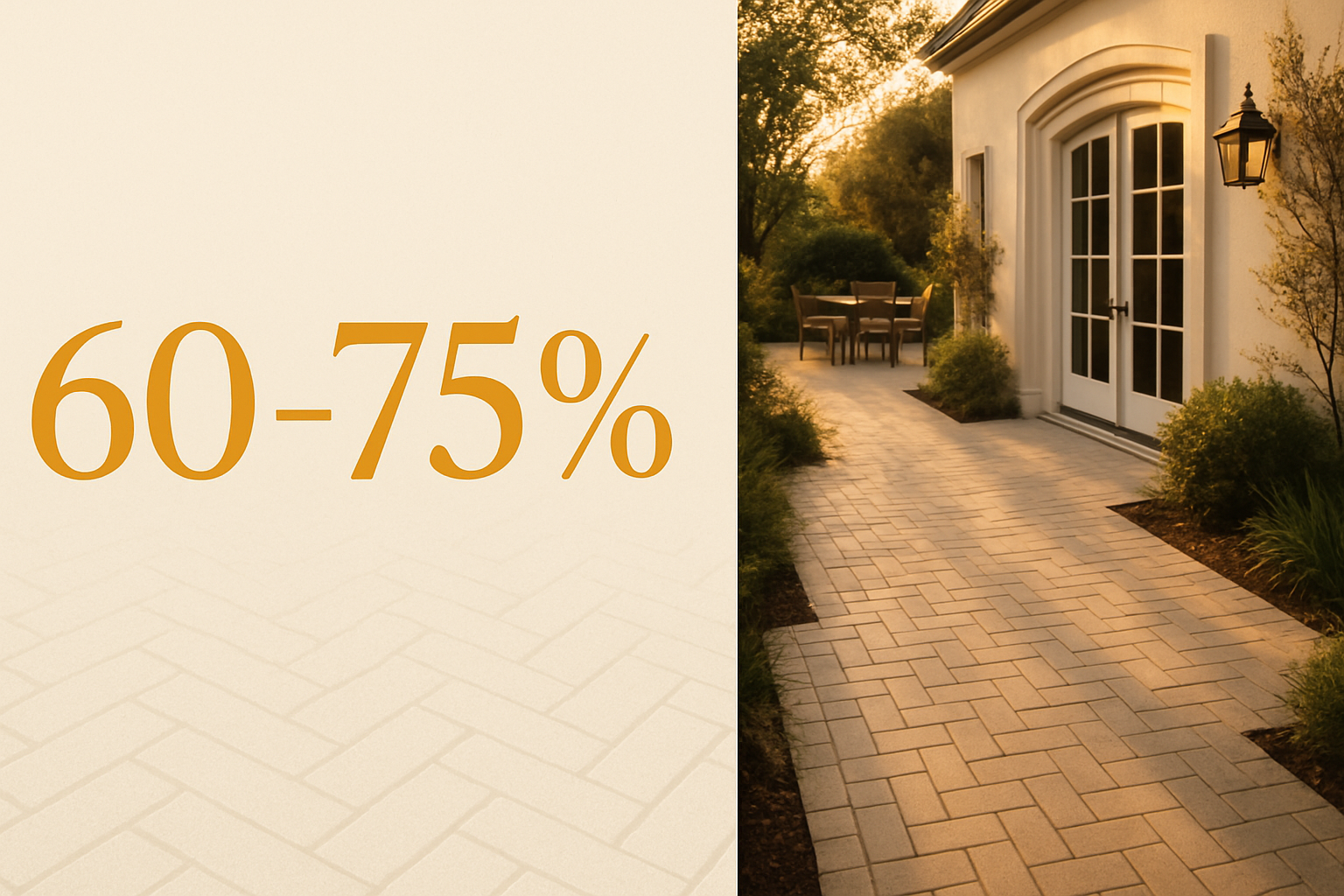
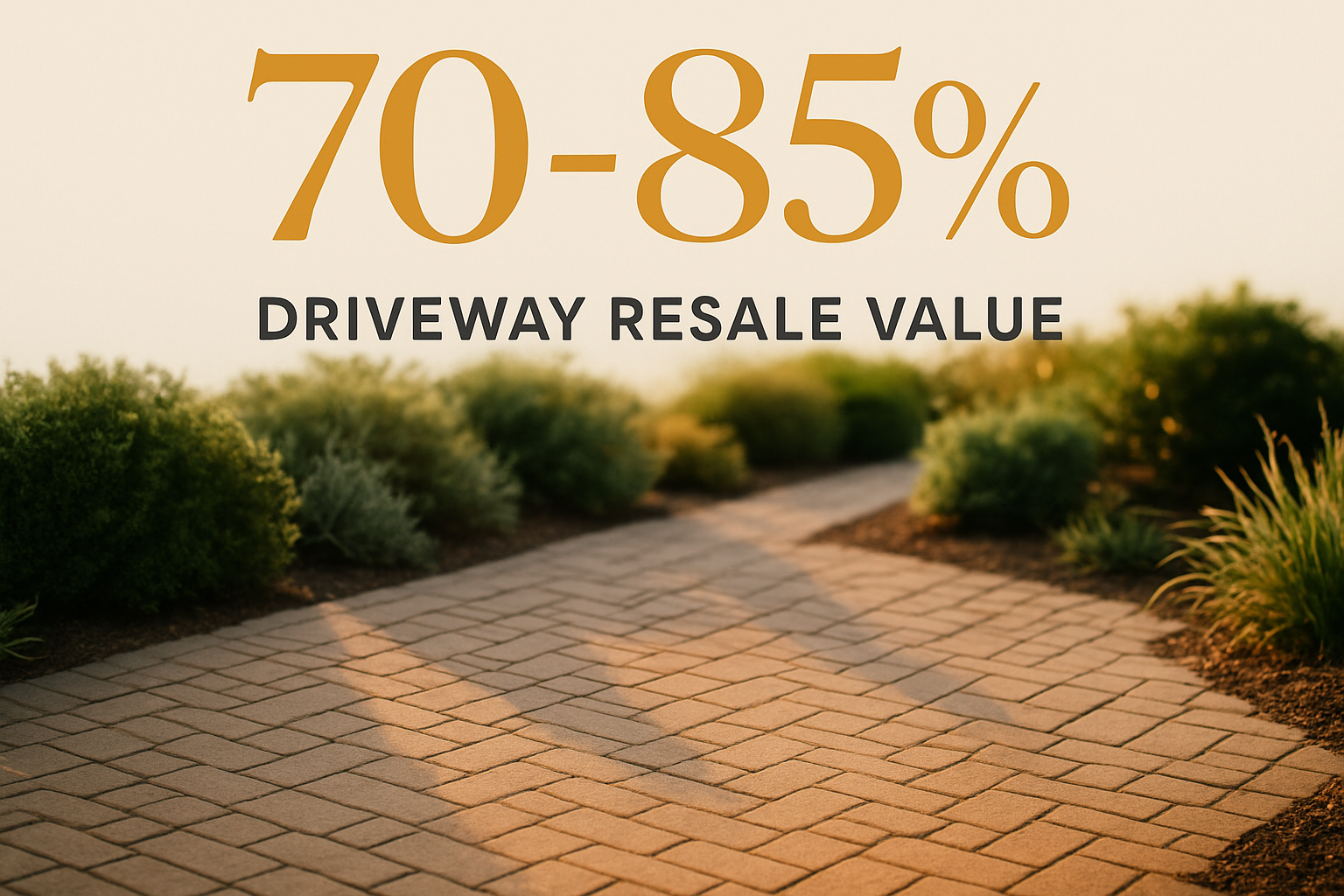
Professional paver installation recovers 60–85% of project cost at East Bay resale — paver driveways recovering highest (70–85%), patios mid-range (60–75%), specialty features lower (40–65%) — and provides transferable warranty documentation that buyers' inspectors verify, lifting list price beyond the contributory value alone.
These aren't round numbers. The Remodeling Cost vs. Value Report (Hanley Wood) documents West Coast hardscape projects recovering cost at rates consistently above the national average. The Appraisal Institute methodology credits contributory value for well-installed hardscape when comparable-sales data supports it — which it does in Lafayette, Walnut Creek, and Danville luxury market comps where hardscape scope and quality is visible in MLS photos.
The transferable warranty is the documentation component buyers' inspectors flag. Lamorinda Pavers provides a 5-year transferable workmanship warranty covering base settlement, drainage failure, edge restraint movement, and joint sand failure — in writing, with our CSLB license number — which records as a property improvement rather than a cosmetic update. That distinction matters to appraisers.
Material choices affect the recovery rate. Classic neutral palettes — Belgard Holland Stone in charcoal, Calstone Country Manor in buff — photograph well, don't trend-date, and appeal to a broad buyer pool. A highly custom pattern or statement color can look specific in ways that narrow buyer appeal at resale.
Lamorinda Pavers builds resale-aware paver installations across Lafayette, Orinda, Moraga, Walnut Creek, and Danville with transferable warranty documentation that buyers' inspectors verify. For the complete ROI breakdown by feature type across East Bay properties, the paver outdoor living ROI guide covers the full property-level math. If you're specifically weighing whether a patio investment will pay off before a planned sale, do paver patios increase home value in the East Bay? addresses the patio ROI question directly with East Bay comp data.
How to verify: Get warranty terms in writing and request explicit transferability confirmation. Confirm the warranty covers base settlement and drainage failure — not just cosmetic finish quality. Confirm the CSLB license number is on the warranty document.
How to Verify These 10 Benefits of Professional Paver Installation During a Bid
Verify the benefits of professional paver installation during a bid by requiring written line items for each — base depth and Proctor density, vehicular paver SKU (driveways), level tolerance spec, ASTM C33 bedding sand, slip coefficient (pool decks), geotextile fabric, French drain plan, paver overage for future repairs, permit pull responsibility, and transferable warranty terms.
The verification checklist, mapped to each improvement:
- Lifespan — Base depth (8–10 inches for driveways, 6–8 for patios), lift sequence in 3-inch increments, geotextile fabric specified, ICPI Tech Spec 2 named in contract
- Vehicle-load capacity — 80mm paver thickness confirmed on spec sheet, base depth 8–10 inches, vehicular polymeric sand (Techniseal HP NextGel or Alliance Gator Maxx) named by SKU
- Level tolerance — ASTM C33 bedding sand named in contract, contractor agrees to level-check in your presence at completion
- Walkway curb appeal — Paver SKU named (Belgard Holland Stone, Calstone Country Manor, or comparable), pattern specified, edge restraint product line named
- Pool deck slip resistance — ASTM E303 wet slip coefficient on paver spec sheet, light-tone colorway confirmed, drainage at coping joint in written spec
- Clay-soil resilience — Non-woven geotextile specified, ICPI Tech Spec 2 compliance named, pattern selection appropriate for load type
- Integrated drainage — Surface slope spec (1 inch per 8 feet minimum), French drain included or explicitly assessed and excluded on-site, Contra Costa stormwater compliance addressed if project exceeds 2,500 sq ft
- Modular repairability — Bedding sand (not mortar) confirmed, paver SKU named with manufacturer certification, 3–5% overage included in bid
- Code compliance — Permit pull responsibility named in contract, CSLB license number provided and verified, sub-trade licenses confirmed for gas/electrical
- Resale recovery and warranty — 5-year transferable workmanship warranty in writing, covers base settlement and drainage failure (not cosmetic only), CSLB license number on warranty document
Lamorinda Pavers itemizes all 10 of these in every paver bid across Lafayette, Orinda, Moraga, Walnut Creek, and Danville. Every bid includes named material SKUs, named base depth and lift sequence, a drainage plan specific to the site's grade and clay profile, and the 5-year transferable workmanship warranty in writing. CSLB License #1092749.
For a broader look at how to evaluate any large paver project before signing — design capability, references, change order terms — 9 questions to vet a paver installer for big patios covers the full vetting framework.
Frequently Asked Questions
What are the benefits of professional paver installation?
The benefits of professional paver installation include 10 measurable upgrades over amateur or cut-rate work: a 25–50 year lifespan (vs. 5–15 years), vehicle-load capacity without settling, patio level tolerance under 1/4 inch over 8 feet, clay-soil resilience without cracking, integrated drainage for East Bay winter rainfall, modular repairability at $50–$200 per paver (vs. $2,000–$10,000 for concrete section replacement), code compliance for permits and stormwater, 60–85% resale recovery, material continuity through named SKUs, and a 5-year transferable workmanship warranty buyers' inspectors verify. Each benefit is verifiable through contract language, material spec sheets, and on-site inspection.
How long do professional paver patios last?
Professional paver patios built to ICPI Tech Spec 2 standards — 6–8 inches of compacted Class II aggregate in 3-inch lifts to 95% Proctor density, non-woven geotextile over native clay, ASTM C33 bedding sand, and polymeric joint sand — last 25–50 years on East Bay clay-soil lots. The paver units themselves (Belgard, Calstone, Techo-Bloc) are rated for 100+ years of service life. The lifespan limit is what's underneath them: a correctly engineered base on Orinda Formation clay outlasts a poorly built base by 20–40 years.
Are pavers better than concrete in California?
On East Bay clay-soil lots — Lafayette, Orinda, Moraga, Walnut Creek, Danville — pavers outperform poured concrete in every measurable dimension. Concrete patios crack at clay-movement joints within 5–7 years on East Bay lots; pavers flex without cracking. Concrete driveways crack under vehicle load on expansive clay within a similar window. Pavers are modular and repairable at $50–$200 per unit; concrete section repair runs $2,000–$10,000. On flat, sandy lots with minimal clay content and good drainage, concrete is a viable alternative — that profile describes very few East Bay residential lots.
How much value does professional paver work add to a home?
Professional paver installation recovers 60–85% of project cost at East Bay resale: driveways recover 70–85%, patios 60–75%, specialty features like outdoor kitchens and fire features 40–65%. The Remodeling Cost vs. Value Report (Hanley Wood) documents West Coast hardscape above national-average recovery rates. The Appraisal Institute methodology credits contributory value for hardscape with documented materials, verifiable contractor licensing, and a written workmanship warranty. For the full breakdown by feature type, the paver outdoor living ROI guide covers the complete property-level math.
Can pavers be repaired without removing the whole driveway?
Yes — individual pavers can be lifted, replaced, and reset without disturbing the surrounding field. A damaged paver costs $50–$200 to replace and takes 1–2 hours. The conditions are that the installation used ASTM C33 bedding sand (not mortar) so pavers can be lifted individually, and that the same paver SKU is still available. This is why naming the exact paver product and manufacturer in the original contract matters — and why keeping 3–5% overage from the original install is standard practice on professionally managed projects.
Why are paver driveways more expensive than concrete?
Paver driveway installation costs 30–60% more than concrete upfront because the base specification is deeper (8–10 inches of Class II aggregate in 3-inch compacted lifts vs. a typical 4-inch concrete pour over minimal base), the paver units require individual hand-placement, vehicular-rated polymeric joint sand is labor-intensive to apply correctly, and PVC edge restraints with 10-inch galvanized spike spacing are required around the full perimeter. On East Bay expansive clay, that base engineering determines whether the driveway lasts 25–50 years or 5–10. The cost-per-year math typically favors the paver premium within the first decade — and the 70–85% resale recovery sharpens the comparison further for anyone planning to sell.
Get All 10 Improvements in Writing
If you want a paver project that delivers all 10 of these benefits of professional paver installation as contract line items — 25–50 year lifespan spec, vehicle-load capacity, level tolerance, clay-soil engineering, integrated drainage, modular repairability setup, code compliance, resale-aware material selection, and 5-year transferable workmanship warranty — request a free on-site estimate from Lamorinda Pavers.
We'll walk the property personally, read the drainage situation, assess the clay profile and grade, and send a fixed-price proposal with each improvement specified in writing within 48 hours. Lifespan, capacity, level, drainage, repairability, code compliance, resale recovery, and transferable warranty — each is a named line item on every bid, not a verbal assurance.
Across Lafayette, Orinda, Moraga, Walnut Creek, and Danville, this is what professional paver installation delivers when scoped correctly.
Contact us to schedule your site visit. CSLB License #1092749.