The Short Answer
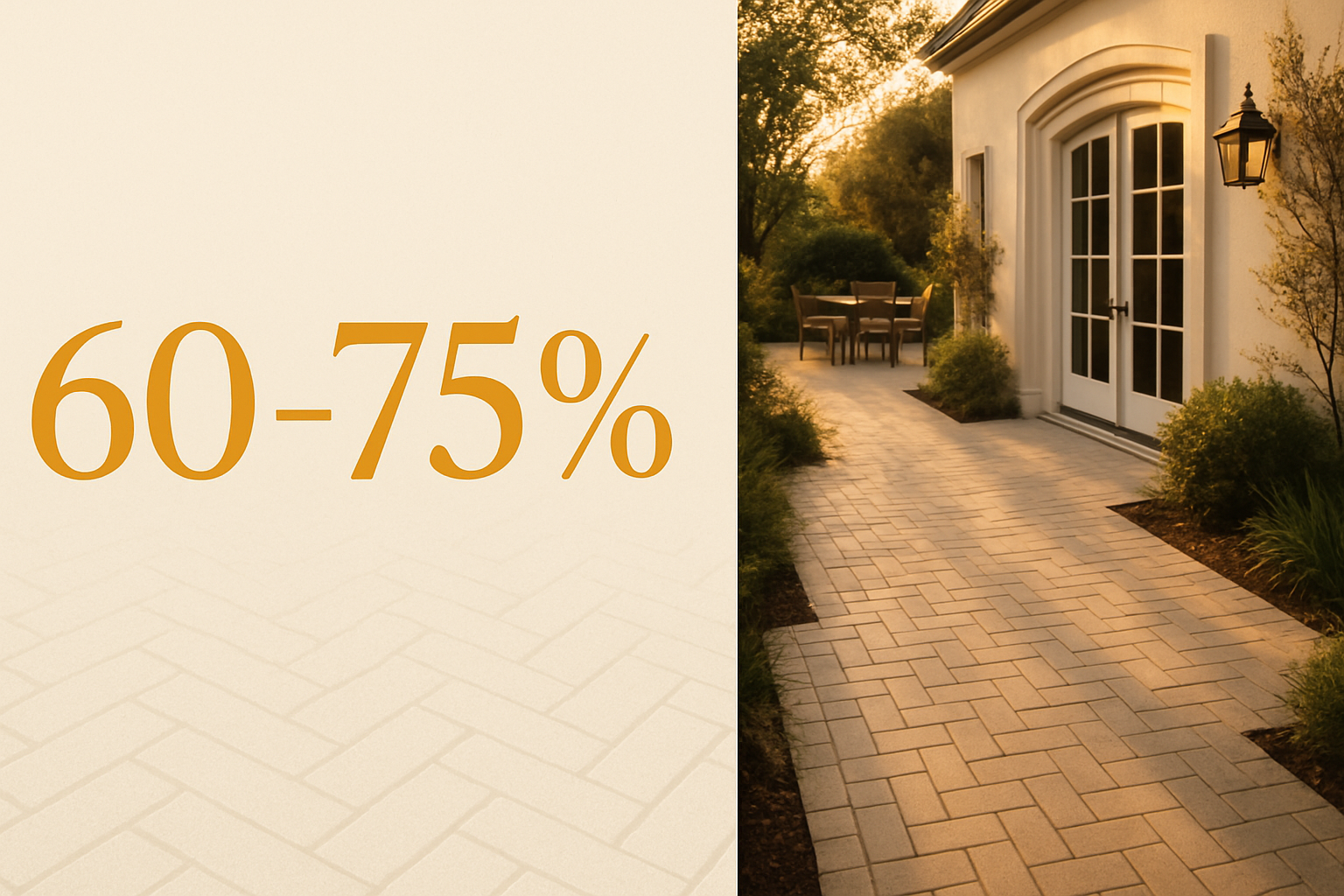
Yes — paver patios increase home value in East Bay markets by 60–75% of project cost on average, with a typical $30K–$60K patio recovering $20K–$45K of contributory home value at resale within 1–3 years of installation. The conditions that determine where you land in that range are installation quality to ICPI Tech Spec 2, neutral classic design choices, documented warranty coverage, and proper pre-listing maintenance. Poorly installed or over-personalized patios can subtract from home value rather than add to it.
Paver patio home value isn't a fixed number — it's a range with real conditions attached. This post breaks down the data, the paver-vs-concrete value gap, how East Bay appraisers actually calculate it, and the design choices that protect or destroy your resale outcome. For the broader picture of how outdoor hardscape improvements stack up against each other, see the broader paver outdoor living ROI guide — this post focuses specifically on patios.
The Data: How Much Value Paver Patios Actually Add in East Bay Markets
Paver patios in East Bay luxury markets — Lafayette, Orinda, Moraga, Walnut Creek, Danville — add $20,000–$45,000 of contributory home value on a typical $30K–$60K install, with the dollar amount scaling with patio size, build quality, and the neighborhood ceiling.
Contributory value is the amount a specific feature adds to a property's total value, which is typically less than the feature's replacement cost because buyers weigh universal appeal heavily. An appraiser never credits you dollar-for-dollar on installation cost — they credit you what the market demonstrates buyers will pay extra to have.
The table below breaks down the value-add by patio scale, using 2026 East Bay project cost data and Appraisal Institute–aligned contributory value estimates:
| Patio size | Typical project cost | Contributory value added | Effective ROI |
|---|---|---|---|
| Small (200–500 sq ft) | $10,000–$20,000 | $7,000–$15,000 | 65–75% |
| Mid (500–1,200 sq ft) | $20,000–$35,000 | $14,000–$25,000 | 65–75% |
| Large (1,200–2,500 sq ft) | $35,000–$70,000 | $22,000–$48,000 | 60–70% |
Paver patios in East Bay markets add $20,000–$45,000 of contributory home value on a typical $30K–$60K install. The Remodeling Cost vs. Value Report, published annually by Hanley Wood, is the industry-standard dataset for tracking ROI on residential improvements — it consistently shows outdoor hardscape returning 50–80% of cost nationally, with high-cost Bay Area markets trending toward the upper end for features with broad buyer appeal.
The ROI percentage compresses slightly at larger patio sizes — not because large patios are less valuable, but because the absolute project cost approaches the neighborhood ceiling faster. A $70,000 paver patio on a $3.5M Lafayette estate stays well within ceiling; the same patio on a $1.4M Concord property is a different conversation.
For a full breakdown of what drives paver patio installation costs before the first shovel, see budgeting a large paver patio.
When Paver Patios Add the Most Home Value (and When They Don't)
Paver patio ROI is not constant — it ranges 40–85% depending on neighborhood, installation quality, design choices, and how much time has passed since install.
When Patios Add MORE Value Than Average (75–85% ROI)
A paver patio returns toward the top of the ROI range when the neighborhood baseline already expects it. On Lafayette hillside homes above $2M — particularly along Happy Valley Road and the surrounding estate streets — and on comparable Orinda properties above Route 24, a finished paver patio isn't a bonus feature: its absence is a deduction. Buyers in these markets price in the cost of adding one themselves, and they discount accordingly.
Three conditions push patio ROI above 75%: the neighborhood tier supports the investment, the patio integrates cleanly with existing landscape design (not just hardscape dropped into an unmaintained yard), and the installation is documented to ICPI Tech Spec 2. ICPI Tech Spec 2 (Construction of Interlocking Concrete Pavements) is the Interlocking Concrete Pavement Institute's installation standard that governs base depth, compaction, edge restraint, and bedding sand tolerances — the benchmark appraisers and inspectors cite when assessing installation quality. Records a buyer's inspector can verify go directly into the appraiser's condition notes.
When Patios Add LESS Value Than Average (40–60% ROI)
ROI compresses when the project cost exceeds the neighborhood ceiling. A $55,000 paver patio installation on a home in a $1.1M–$1.4M price band recovers a smaller percentage than the same patio on a $2.2M property — not because the patio is worth less in absolute terms, but because comparable buyers in that tier cap what the feature contributes. Neighborhood ceiling is hard: contributory value cannot exceed what the market supports, regardless of installation quality.
ROI also drops when a listing is 5+ years post-install without any maintenance. Faded sealer, washed-out polymeric joint sand, and visible edge-restraint movement each read as neglect to buyers and appraisers alike — and appraisers adjust contributory value downward accordingly.
When Patios SUBTRACT Value From a Property
A paver patio subtracts from a property's value when its condition signals a project for the next buyer rather than an asset for the current one. Visible settling, cracked paver units, washed-out joint lines, and standing water after rain shift the appraisal conversation from "what does this add?" to "what does it cost to fix?" That question comes back as a negotiating lever — or a buyer walkaway.
Patios with outdated design choices — a 2014-era cobalt-border inlay or a medallion pattern that reads too personalized — can also push buyers to mentally price in removal cost rather than pay a premium for the feature. A patio that requires a $15,000 remediation conversation isn't a $24,000 asset; it's a liability.
To understand what happens when base compaction fails — often the root cause of the settling that triggers these conversations — see what paver base compaction actually is and why it matters.
How East Bay Appraisers Weigh Paver Patios Specifically
East Bay appraisers value paver patios using the sales comparison approach — they identify recent comparable sales with and without paver hardscape, then adjust the comp value upward by the contributory value the patio adds to sale price, typically 60–75% of replacement cost for premium installations.
Under Appraisal Institute methodology, every dollar of contributory value must be defensible against actual comparable sales data. An appraiser working a $1.8M Walnut Creek transaction doesn't take a contractor's $35,000 bid at face value. They find comparables — recent Walnut Creek paver projects that sold with and without similar hardscape — and calculate the demonstrated market premium. If the comparable pool is thin, the appraiser's ability to support a high contributory value is limited regardless of installation quality.
What appraisers actually examine at inspection:
Installation documentation. Warranty paperwork, ICPI references, and base depth documentation signal build quality that an appraiser can cite by name. A 5-year transferable workmanship warranty isn't a verbal assurance — it's a document with terms a buyer's inspector can read and an appraiser can reference. That distinction matters in the condition narrative.
Age and condition. A 3-year-old paver patio in maintained condition typically appraises higher than an 8-year-old patio without maintenance records — not because age is inherently problematic, but because sealer degradation and joint sand loss are visually apparent at that point. Maintenance documentation closes the gap.
Integration with the property. A patio that flows naturally into the yard's grade and landscape design reads as a planned improvement. One that was dropped into a yard without drainage consideration raises a question about what's happening below the surface — and appraisers note those questions.
Neighborhood comp data. In Lafayette, Orinda, and Moraga, appraiser comparable data increasingly supports paver patio premiums at the $1.5M+ price point. Below that threshold, comparable evidence is thinner and contributory value ranges compress. In Danville and Walnut Creek's flatter neighborhoods, comparable data is more robust across a wider price band.
Paver Patio vs. Concrete Patio — The Value Impact Difference
Paver patios consistently outperform concrete patios on East Bay home resale by 15–25 percentage points of ROI — driven by buyer perception of permanence, the structural advantage on clay soil, and the maintenance replaceability of individual paver units.
Three reasons the gap is real and quantifiable:
1. Permanence perception. Buyers read a paver patio as a designed installation — pattern choice, edge detailing, material selection. They read a poured concrete slab as standard surfacing. That distinction moves in appraisal conversations and in offer psychology. A buyer touring a $2M Orinda home doesn't respond to herringbone Belgard the same way they respond to a broom-finish slab. The design vocabulary itself signals investment.
2. Clay-soil structural advantage. Expansive clay is soil that swells when wet and shrinks when dry, with seasonal volume change of 5–10%. Concrete patios crack at clay-movement joints within 5–7 years on East Bay lots. Expansive clay underlies most of Lafayette, Orinda, and Moraga — rigid concrete can't absorb that seasonal movement without cracking. Interlocking concrete pavers flex with that movement instead of resisting it. A buyer's inspector who sees hairline cracks in a 6-year-old concrete patio writes it as a condition issue. A well-maintained paver patio at the same age shows nothing. For the specific drainage dynamics that make clay soil a build-phase decision point, see 11 DIY paver patio mistakes that ruin drainage.
3. Replaceability. If a delivery vehicle damages one corner of a paver patio, you replace those specific units. You don't resurface the entire slab. That serviceability matters to buyers who've watched a concrete repair fail to color-match the original pour.
A $25,000 paver patio recovers $16,000–$19,000 of value at resale on a Walnut Creek $1.8M home; an equivalent $15,000 concrete patio recovers $6,000–$9,000. Paver patios outperform concrete patios on East Bay resale ROI by 15–25 percentage points — the honest range, not an overclaim.
Curb-Side Paver Walkways vs. Backyard Patios — Different Value Mechanics
Curb-side paver walkways return a higher percentage of cost at resale (70–80%) than backyard patios (60–75%), but backyard patios contribute more total dollar value because the project scope is larger.
The mechanic works differently by location. Front walkways generate first-impression value — they appear in every listing photo and signal property-wide maintenance quality before a buyer steps out of the car. A clean paver walkway from the street to the front door on a Moraga or Danville home tells a story about how the property was managed. That story moves offer-price anchors.
Backyard patios generate use-value and lifestyle appeal — Saturday entertaining, year-round outdoor dining, the reason a buyer requests a second showing. They influence which buyers come back, not the offer-price anchor they bring when they do.
The math makes both worth doing for different reasons. A $10,000 front walkway recovers $7,000–$8,000 in contributory value — high percentage, lower absolute. A $40,000 backyard patio recovers $24,000–$30,000 — lower percentage, higher absolute. On a typical East Bay listing, the front walkway influences offer price; the backyard patio influences buyer-showing requests.
For how paver driveway installation fits into the curb-appeal value picture, the ROI mechanics are similar to walkways but at a larger project scale — typically the highest-percentage ROI of any individual hardscape feature on properties where the driveway is a visible street-facing element.
Design Choices That Maximize Paver Patio Resale Value
Five design choices reliably maximize paver patio resale value: classic patterns, neutral colors, standard premium pavers, proper drainage engineering, and a layout that flexes to multiple configurations.
Classic patterns. Herringbone and running bond are the patterns appraisers and buyers recognize as timeless. Herringbone in particular photographs with a visual depth that reads well in listing images — it communicates intentional design without committing to a trend. Basketweave and random-modular layouts hold value well too. Patterns tied to a single design-trend moment don't transfer cleanly to buyers with different aesthetics.
Neutral color palettes. Gray-tan-brown colorways — Belgard Holland Stone in buff and charcoal, Calstone Country Manor in earth tones — photograph cleanly across seasons and lighting conditions. They don't date the installation. A buyer who wants to add a pergola or arbor structure or outdoor kitchen later can build to a neutral paver field without a style conflict.
Standard premium pavers. Belgard and Calstone are the regional premium brands that buyers, appraisers, and inspectors recognize as quality markers. Mid-tier lines in these brands — Belgard Mega-Arbel, Calstone Venetian — hit the quality signal without the cost premium of specialty imports. Named brands in the bid give appraisers something concrete to cite.
Proper drainage engineering. A patio with a 1–2% slope away from the house structure, correctly graded to daylight or a catch basin, doesn't pool. A patio that pools after winter rain gives a buyer's inspector a line item to write. Drainage isn't a design aesthetic — it's a resale-value protection mechanism. For the full drainage engineering checklist relevant to East Bay clay lots, see how to install a level paver patio that won't shift.
Flexible layout. An open hardscape field with generous circulation lets the next buyer configure dining and lounge zones as they choose. A layout built specifically around one furniture arrangement or a fixed water feature transfers less cleanly to a buyer with different habits.
For a complete checklist of what separates a basic patio install from a full-service build, see 12 features full-service paver patios should include.
Design Choices That Diminish Paver Patio Resale Value
Four design choices reliably diminish paver patio resale value: bright or unusual paver colors, custom inlays tied to a specific trend, poor drainage, and over-improvement above the neighborhood ceiling.
Bright or unusual colors. A cobalt-border inlay or terracotta-dominant field that reflects personal taste signals a renovation project to the next buyer — they're calculating removal or concealment cost before they've calculated what they'd enjoy about the space. That calculation moves in the wrong direction for your offer price.
Custom inlays and trend-dated patterns. Decorative medallions, compass-rose inlays, and pattern choices popular in a specific design era mark the installation's age in a way neutral palettes don't. A buyer touring an Orinda property with a 2015-trend inlay reads "dated" — which affects offer psychology even when the structural condition is sound.
Poor drainage that causes visible pooling or settling. Standing water and visible paver settlement tell a buyer's inspector the base wasn't built correctly. This isn't a minor condition note — it raises questions about what's happening below the surface and what correction costs. That question comes back as a negotiating point or a buyer walkaway. For what causes patio sinking specifically, see how to prevent paver patio sinking in 2026.
Over-improvement above the neighborhood ceiling. An $80,000 paver patio on a $1.2M Concord home is unlikely to recover above 35% because the upgrade exceeds the neighborhood ceiling. Contributory value is always market-derived — the neighborhood sets the ceiling, not the installation quality. For the full outdoor living context across all hardscape feature types, see the broader paver outdoor living ROI guide.
Worked Example: $35,000 Paver Patio on a $1.8M Walnut Creek Home
A $35,000 paver patio installed on a $1.8M Walnut Creek home in 2026 typically recovers $22,000–$26,000 in contributory market value at resale within 1–3 years — a 63–74% effective ROI — assuming neutral design, ICPI-spec installation, and pre-listing reseal.
The math, line by line:
- Original installation: $35,000 (Belgard Mega-Arbel in running bond, 8-inch compacted Class II base, polymeric joint sand, full edge-restraint perimeter)
- Pre-listing refresh at year 2: $3,500 (power-wash, reseal, joint sand refresh, minor spot leveling)
- Total seller cost: $38,500
- Contributory market value recovered at sale: $24,000 (based on Walnut Creek comparable sales premium for paved outdoor living)
- Net effective ROI: 62%
- Time-on-market reduction: 7–12 days faster than comparable Walnut Creek homes without the patio
That 7–12 day reduction matters. Price reductions typically begin at day 21 in competitive East Bay markets. A faster sale at asking price is worth more than a longer sale with concessions — and the speed benefit is documented in Walnut Creek paver projects transaction patterns, not estimated.
A $35,000 paver patio on a $1.8M Walnut Creek home typically recovers $22,000–$26,000 at resale — a 63–74% effective ROI on the full seller cost including pre-listing maintenance.
Lamorinda Pavers builds resale-aware paver patios across Walnut Creek, Lafayette, Orinda, Moraga, and Danville — design choices, material specs, and warranty structure all built to hold contributory value when the property eventually sells.
How to Protect Resale Value on an Existing Paver Patio
East Bay homeowners with existing paver patios can protect or lift resale value with four pre-listing improvements: power-wash and reseal, polymeric joint sand refresh, visible settling repair, and strategic plantings to soften hardscape edges.
Power-wash at 1,200–1,500 PSI and reseal. Cost: $1,500–$3,500. This is the single highest-return pre-listing investment on existing hardscape. Clean, sealed pavers in listing photos communicate a maintained property — the message that supports list price and appraiser contributory-value calculations. Resealing cadence should be every 3–5 years per ICPI maintenance guidance.
Polymeric joint sand refresh. Cost: $1,500–$4,000 depending on square footage. Washed-out joint lines read as neglect in person and in photos. Refreshed joint sand brings the surface back to installed condition visually and eliminates one of the items a buyer's inspector would flag during the condition review.
Fix visible settling or edge-restraint failures. Cost: $500–$2,500 for spot repairs. A buyer's inspector who flags settling at inspection turns that note into a negotiating lever on your sale price. Fixing it before listing costs a fraction of what it costs to lose in negotiation. For a systematic look at why settling happens and how it's corrected at the base level, see how to prevent paver patio sinking in 2026.
Add 3–5 ornamental plantings to soften hardscape edges. Cost: $300–$1,500. A patio with nothing but hardscape reads as sparse in listing photos. Three ornamental grasses at the corners and two potted olive trees along the perimeter add warmth and depth to the listing image without significant cost — and soften the hardscape in a way that makes the overall landscape design read as intentional.
A pre-listing maintenance pass of $3,000–$8,000 on an existing paver patio typically lifts list price by $12,000–$30,000 on East Bay luxury properties. That's a 2:1 to 4:1 return on the maintenance investment — which holds regardless of how many years ago the original installation happened.
How Lamorinda Pavers Designs Paver Patios for Resale Value
A paver patio installation that holds resale value uses ICPI-spec build quality, a classic neutral material palette, documented warranty coverage, and a flexible layout — design choices Lamorinda Pavers builds into every paver patio installation across Walnut Creek, Lafayette, Orinda, Moraga, and Danville.
Build standard. Every paver field is built to ICPI Tech Spec 2 — the Construction of Interlocking Concrete Pavements standard — with 6–8 inches of compacted Class II base aggregate on standard lots and 8 inches minimum on Lafayette and Orinda clay lots where expansive soil requires deeper preparation. ICPI (the Interlocking Concrete Pavement Institute) is the U.S. trade body that sets installation standards for interlocking concrete pavers — their Tech Spec 2 is the document appraisers and inspectors reference when assessing whether a patio was built to hold. Base compaction is Proctor-tested at each phase, not assumed. A buyer's inspector who asks about base depth gets a written answer, not a verbal estimate.
Material palette. Paver selections default to Belgard and Calstone in neutral earth tones — buff, charcoal, tan, and natural gray colorways that photograph cleanly across seasons. Herringbone and running bond are the default patterns: they read as classic across multiple buyer design preferences and don't date the installation to a specific trend moment. For how paver pattern and material selection interact with the full outdoor living build, see 9 questions to vet a paver installer for big patios.
Joint sand. Techniseal HP NextGel polymeric joint sand, installed per manufacturer spec, with a documented reseal schedule every 3–5 years. Reseal records go in the project file — they're documentation that survives a property sale and gives the next owner a maintenance baseline.
Warranty. Every paver patio carries a 5-year transferable workmanship warranty covering base settlement, drainage failure, edge-restraint movement, joint sand failure, and hardscape-to-structure tie-in failure attributable to installation defect. Transferable means it survives the sale — a buyer's inspector can verify it, read the coverage terms, and factor it into the condition assessment. That documentation is what separates a claim of quality from evidence of it.
Frequently Asked Questions
Do paver patios add value to a home?
Yes — a properly installed paver patio returns 60–75% of project cost as contributory market value at resale in East Bay markets. On a $35,000 paver patio at a $1.8M Walnut Creek home, that's $22,000–$26,000 in additional sale price relative to a comparable home without it. Installation quality, maintenance condition, and design neutrality all determine where in that range you land — a poorly maintained or over-personalized patio can return well below 60%, or subtract value if condition is poor enough.
How much does a paver patio increase home value in the Bay Area?
A paver patio increases Bay Area home value by 60–75% of project cost on average, translating to $20,000–$45,000 of contributory value on a typical $30K–$60K East Bay install. The Remodeling Cost vs. Value Report (Hanley Wood) consistently shows outdoor hardscape near the upper end of the national 50–80% range in high-cost Bay Area markets. Dollar recovery scales with patio size: small patios (200–500 sq ft) recover $7,000–$15,000; large patios (1,200–2,500 sq ft) recover $22,000–$48,000.
Are paver patios better than concrete for resale?
Paver patios outperform concrete patios on East Bay resale ROI by 15–25 percentage points. The gap comes from three factors: buyers perceive pavers as a designed installation while concrete reads as standard surfacing; concrete cracks at clay-movement joints within 5–7 years on East Bay lots while pavers flex without cracking; and individual paver units can be replaced without redoing the surface. A $25,000 paver patio on a $1.8M Walnut Creek home recovers $16,000–$19,000; an equivalent $15,000 concrete patio recovers $6,000–$9,000.
When should I install a paver patio before selling my home?
The highest-ROI timing window is 1–3 years before listing. At that point, the installation looks maintained rather than brand-new, any plantings softening the hardscape edges have established, and warranty documentation is current and active. Installing within 6 months of listing still recovers value, but expect 10–15 percentage points below the optimal range — the construction look hasn't settled. If you're listing within 60–90 days, a pre-listing maintenance pass (reseal, joint sand refresh, settling repair) on existing hardscape typically delivers a better return than a new paver patio installation.
Do East Bay appraisers value paver patios?
Yes — East Bay appraisers value paver patios using the sales comparison approach under Appraisal Institute methodology. They find recent comparable sales with and without similar hardscape and adjust the comp value upward by the demonstrated contributory value of the patio, typically 60–75% of replacement cost for premium installations. Appraised value is market-derived, not cost-derived. A patio with ICPI-spec build documentation and an active transferable warranty gives the appraiser something to cite; visible settling gives them reason to discount.
What paver patio design has the best resale value?
Classic patterns in neutral palettes hold the best paver patio resale value. Herringbone and running bond in gray-tan-brown colorways — Belgard Holland Stone in buff and charcoal, Calstone Country Manor in earth tones — photograph well, age gracefully across buyer cohorts, and don't trend-date the installation. Avoid bright colors, custom inlays, and layouts built around a single furniture configuration. An open, flexible hardscape field transfers more cleanly to a buyer with different habits and aesthetics.
Build a Patio That's Both Used and Recoverable
If you're planning a paver patio installation with resale value in mind — neutral design, classic materials, ICPI-spec build quality, documented warranty — request a free on-site estimate from Lamorinda Pavers. We'll walk the property, scope the patio with a resale-aware design lens, and send a fixed-price proposal with material specs that hold appraisal value over time.
Every Lamorinda project comes with named Belgard or Calstone paver selections, ICPI Tech Spec 2 build documentation, Techniseal polymeric joint sand installed to spec, and a 5-year transferable workmanship warranty that buyers' inspectors can verify. The base depth is documented, not assumed. The paver pattern goes in the bid as a named choice — herringbone, running bond — not "pattern TBD."
Across Walnut Creek, Lafayette, Orinda, Moraga, and Danville, this is how paver patios get built to be both used and recoverable when the property eventually sells. Contact us to schedule your site visit.