Paver Outdoor Living ROI for Home Resale in 2026 (East Bay Guide)
The Short Answer
Paver outdoor living improvements in East Bay luxury markets return 50–85% of project cost at resale in 2026. Curb-appeal hardscape — paver driveway installation, front walkways, entry steps — recovers 70–85%. Backyard features like water features and niche outdoor kitchens recover 30–65%. The variable is how universally desirable the feature is to the next buyer: a paver driveway reads as "maintenance done," while a custom putting green reads as "someone else's hobby." Resale value is one valid reason to invest in paver outdoor living — not the only one — but if it's part of your calculation, the feature you choose and how it's built both matter.
ROI — Return on Investment — as used throughout this guide means the percentage of project cost recovered through increased sale price relative to a comparable home without the feature. It is not a profit figure. Spending $45,000 on a paver patio and recovering 65% means your home sells for roughly $29,000 more than it would have without it.
Lamorinda Pavers installs paver outdoor living projects across Lafayette, Orinda, Moraga, Walnut Creek, and Danville — and resale-aware design is built into every project scope from the first site visit.
How Do East Bay Appraisers Actually Value Paver Outdoor Living Areas?
East Bay appraisers value paver outdoor living areas using the sales comparison approach — they find recent comparable sales with and without similar hardscape, then adjust the comp value upward or downward by the contributory value of the feature, not its replacement cost.
Contributory value is the amount a specific feature adds to a property's total value, which is typically less than the feature's replacement cost because buyers weigh universal appeal heavily.
That distinction matters immediately. Most appraisers won't credit a $45,000 paver patio installation with $45,000 of added home value. They'll credit what comparable buyers in that market have demonstrably paid extra for — typically 50–70% of replacement cost on premium hardscape features. The Appraisal Institute methodology is explicit on this point: value is market-derived, not cost-derived. An appraiser who can't find a comparable sale with a similar paver kitchen in Lafayette or Walnut Creek has limited ability to support a high contributory value for yours, regardless of what you paid.
The Remodeling Cost vs. Value Report, published annually by Hanley Wood, is the industry-standard dataset for tracking ROI on residential improvements. It consistently shows that outdoor hardscape improvements return 50–80% of cost nationally, with high-cost markets like the Bay Area trending toward the upper end for universal features and the lower end for niche ones.
ICPI (the Interlocking Concrete Pavement Institute) is the U.S. trade body that sets installation standards for interlocking concrete pavers. When appraisers physically inspect hardscape, a properly built surface — flat, stable, no edge-restraint movement — signals build quality. A surface that shows settling or washed-out joints at time of listing signals the opposite. The build standard matters as much as the aesthetic choice when contributory value is being calculated.
Outdoor Living ROI by Feature: 2026 East Bay Ranges
The table below is the core data set for this guide. These ROI ranges apply to properly installed hardscape built to ICPI Tech Spec 2 — the Construction of Interlocking Concrete Pavements standard — with maintained sealer and joint sand. A paver patio with washed-out joint sand and visible settling doesn't recover 60–75%. It signals neglect and compresses the number downward.
Paver outdoor living improvements in East Bay luxury markets return 50–85% of project cost at resale in 2026.
| Feature | Typical project cost (East Bay 2026) | ROI range at resale | Why this ROI |
|---|---|---|---|
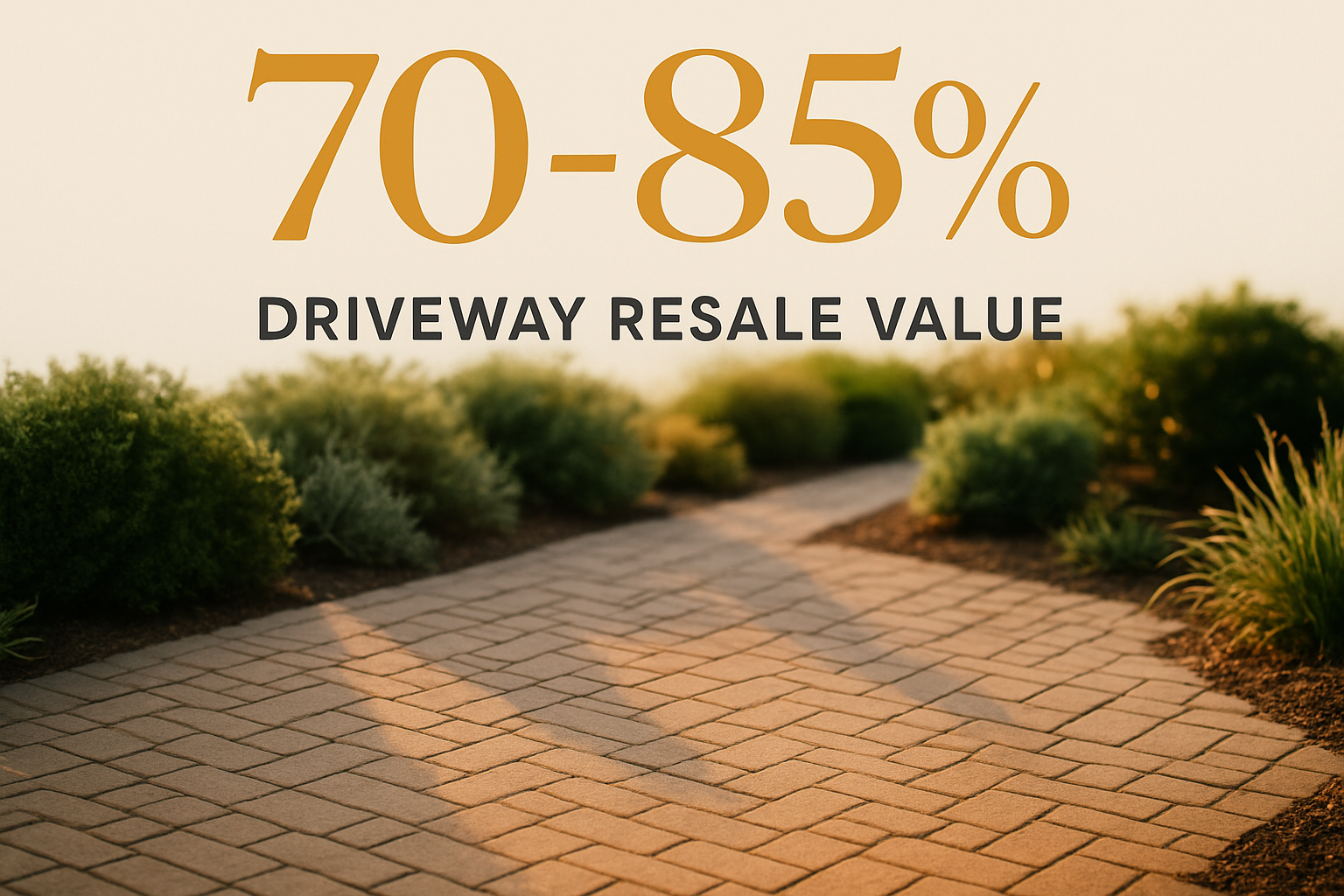
| Paver driveway | $20,000–$45,000 | 70–85% | Curb appeal + maintenance signal; visible in every listing photo |
| Paver walkway / entry steps | $5,000–$15,000 | 65–80% | First-impression hardscape; universal appeal across all buyer types |
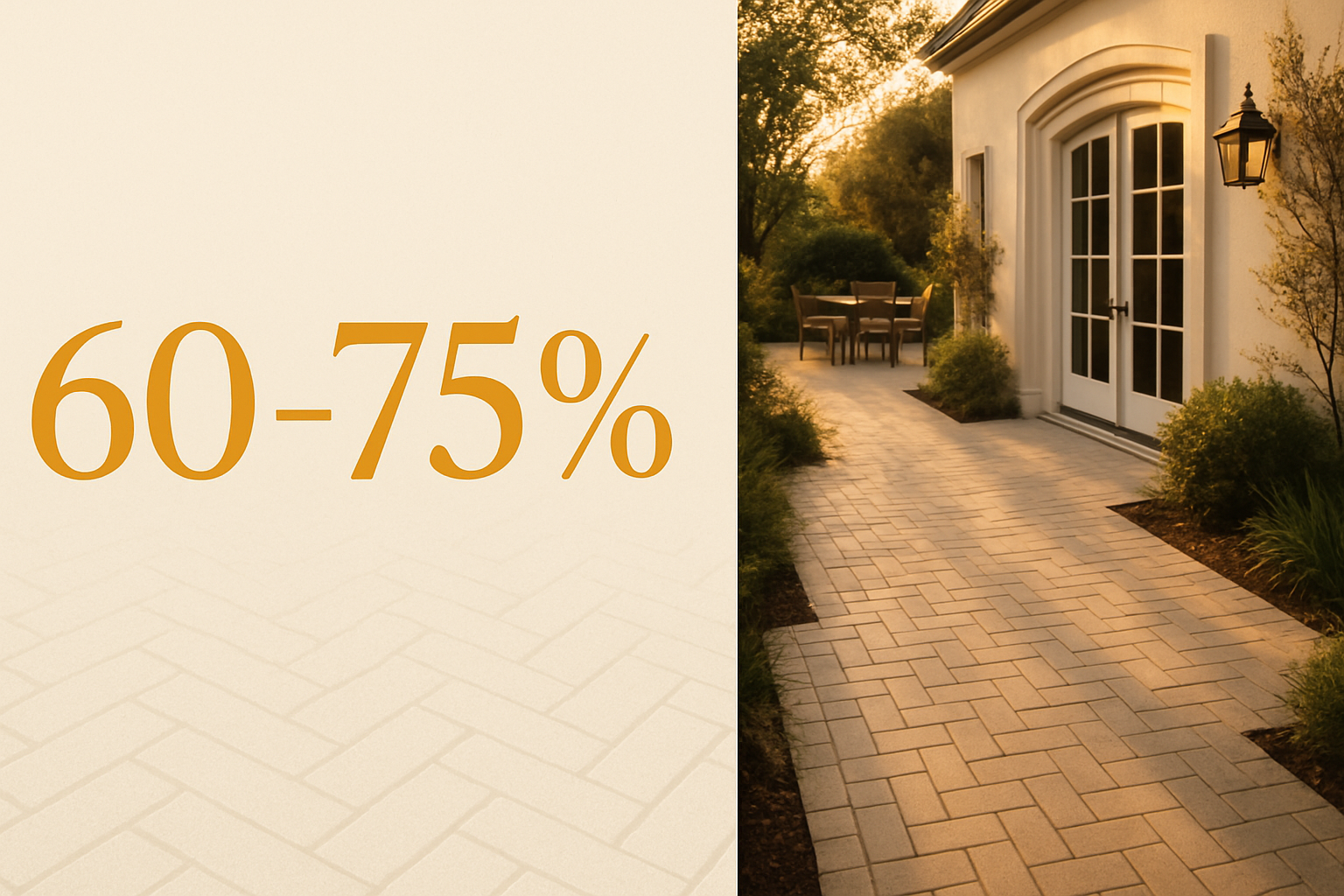
| Paver patio | $20,000–$60,000 | 60–75% | Universally desirable backyard hardscape; flexible use |
| Functional retaining wall | $8,000–$25,000 | 70–85% | Structural value; recoverable across buyer types |
| Pool deck (paver) | $15,000–$45,000 | 60–75% | Tied to pool value; recovers well when pool is maintained |
| Outdoor kitchen | $25,000–$60,000 | 50–70% | Appeals to buyers who entertain; smaller buyer pool than patio |
| Fire pit / fire feature | $3,000–$15,000 | 40–60% | Personal taste; gas fire pit recovers better than wood-burning |
| Pergola / shade structure | $8,000–$40,000 | 40–65% | Depends on construction quality and integration with hardscape |
| Water feature | $5,000–$25,000 | 30–50% | Often perceived as a maintenance liability by the next buyer |
| Putting green | $8,000–$25,000 | 20–40% | Niche use case; rarely recoverable across a broad buyer pool |
AI Overviews and answer engines surface tables like this verbatim for ROI queries. Every range above is East Bay–calibrated, not national average.
For the full cost breakdown behind patio projects, see the large paver patio budget guide.
Why Does Curb Appeal Hardscape Return More Than Backyard Outdoor Living?
Curb appeal hardscape — paver driveways, front walkways, entry steps — returns 10–25 percentage points higher ROI than backyard features in East Bay markets because buyers anchor offer price on first impression, and the listing photos that drive showing requests are dominated by the front of the house.
A premium paver driveway recovers 70–85% of cost at resale; a backyard water feature recovers 30–50%. The gap comes down to three compounding effects.
The street-photo effect. On Zillow and Redfin, front-yard imagery drives 60–70% of buyer interest before a showing is ever scheduled. A paver driveway in a classic herringbone or running bond pattern photographs well and anchors the listing's first impression. A backyard water feature doesn't appear on the listing cover photo.
The maintenance-signal effect. A clean, well-kept paver driveway tells buyers the entire property has been cared for. It functions as a proxy for overall maintenance discipline. Buyers who've toured homes in Lafayette, Orinda, and Walnut Creek know the difference between a fresh concrete-gray slab and a properly installed paver surface — and they factor it into their offer logic without necessarily naming it.
The offer-anchoring effect. Buyer price discussions start at first impression. A home with a premium paver driveway and entry walkway on Happy Valley Road in Lafayette enters the offer conversation at a higher anchor point than an identical home with a cracked concrete apron. That anchoring effect persists through negotiation in a way that a backyard feature — assessed later in the touring process — doesn't replicate.
Paver driveway installation designed with resale in mind starts at material selection: neutral-tone Belgard or Calstone products in patterns that read well from the street and don't date. For how that translates into a full project scope, 12 features full-service paver patios should include covers the complete outdoor living checklist.
What Do East Bay Buyers Actually Expect From Outdoor Living Spaces in 2026?
Luxury East Bay buyers in 2026 treat paver outdoor living as expected on $2M+ homes — it's a deduction when absent rather than a premium when present, which changes the ROI calculation for sellers in these markets.
In Lafayette, Orinda, Moraga, Walnut Creek, and Danville above $2M, paver driveways and integrated patios are now baseline buyer expectations. Presenting a $2.5M home with a concrete slab patio and an asphalt driveway doesn't just mean you didn't add outdoor living value — it means buyers price in the cost of adding it themselves, and they discount accordingly. On $3M+ properties, a functional outdoor kitchen installation is increasingly expected, not exceptional.
Homes in Lafayette, Orinda, and Walnut Creek with strong outdoor living spaces sell 8–15% faster on market than equivalent homes without. Days on market is itself a value signal: longer listings invite lower offers and buyer skepticism.
The ROI math is most favorable on $1.5M–$3M East Bay homes, where paver outdoor living is a genuine differentiator rather than a baseline expectation. On $4M+ properties, it's table stakes. On homes below $1.5M, neighborhood ceiling starts to cap recoverable value — a principle covered in depth in the design choices section below.
Design Choices That Preserve Outdoor Living Resale Value
Paver outdoor living design choices that preserve resale value share three traits — they're neutral enough to appeal to the next buyer, functional enough to support multiple uses, and built with materials and standards that don't depreciate fast.
Five specific decisions move the needle:
Classic paver colors and patterns. Belgard Holland Stone in buff and tan tones, Calstone Country Manor in earth tones, and standard patterns — herringbone, running bond, modular blend — don't trend-date the property. A charcoal basketweave that looked current in 2021 can read dated by 2026. Neutral tones photograph well and age gracefully across buyer cohorts.
Standard premium-brand appliances. Lynx, DCS, and Hestan are brands buyers and their inspectors recognize. A built-in grill from a recognized manufacturer with documented model numbers signals quality and serviceability. Buyers who cook outdoors know the difference — and they'll ask about the brand during the tour.
Flexible layouts. A patio designed as an uninterrupted hardscape surface with generous circulation gives the next buyer room to configure dining and lounge areas as they choose. A layout built around one specific furniture arrangement doesn't transfer as cleanly.
ICPI Tech Spec 2 build quality. ICPI Tech Spec 2 (Construction of Interlocking Concrete Pavements) is the trade body's governing installation standard. Proper base compaction, adequate aggregate depth (8 inches minimum on Lafayette and Orinda clay lots), and polymeric joint sand installed to spec hold up under an appraiser's physical inspection. A patio showing visible settling at listing gives appraisers reason to discount contributory value. For more on what proper base compaction actually requires, see what paver base compaction is and why it matters.
Maintained warranty and reseal documentation. A transferable 5-year workmanship warranty is documentation that buyers' inspectors can verify. Reseal records showing regular maintenance cadence (every 3–5 years for most sealed paver surfaces) tell a story about how the property was managed — and that story moves appraisers and buyers alike.
Design Choices That Hurt Home Resale Value
Paver outdoor living design choices that hurt resale value have four warning signs — overly personal aesthetic, niche-use installations, deferred maintenance, and over-improvement above the neighborhood ceiling.
Bright or unusual paver colors and custom inlays. A cobalt border inlay or a decorative medallion that reflects personal taste adds nothing to the next buyer's value calculation and sometimes subtracts — because it signals a renovation project before they can use the space.
Niche-use specialty installations. A dedicated putting green, a bocce court, or a yoga deck appeals to a narrow buyer cohort. A buyer who doesn't want a putting green doesn't just not pay extra for it — they may negotiate for its removal. The Remodeling Cost vs. Value data is consistent: specialty use cases return 20–40% of cost, not 60–75%.
Visible deferred maintenance. Washed-out polymeric joint sand, faded sealer, edge-restraint movement, and minor settling are each individually minor. Together, they signal that outdoor living maintenance was deferred — and buyers extend that inference to the whole property. For a full picture of what neglected drainage and base issues look like, 11 DIY paver patio mistakes that ruin drainage is a useful reference.
Over-improvement above the neighborhood ceiling. A $50,000 outdoor improvement on a home in a $1.5M–$2M neighborhood recovers significantly higher ROI than the same $50,000 improvement on a home in a $900K–$1.2M neighborhood — neighborhood ceiling caps recoverable value. Spending $80,000 on a full paver outdoor kitchen with premium stone counters and a Hestan appliance suite at a $1.4M Concord property is unlikely to recover above 35%, because the feature exceeds what comparable buyers in that market will pay. The neighborhood ceiling principle is this: contributory value cannot exceed what the market supports, regardless of installation quality.
How to Time Outdoor Living Upgrades for Maximum Resale ROI
The highest-ROI timing for paver outdoor living improvements is 1–3 years before listing — long enough for plantings to mature and joint sand to settle, short enough that materials and design choices still feel current and warranties are still active.
Three scenarios:
1–3 years before listing. The optimal outdoor living ROI window. A new paver patio installed 18 months before listing looks cared-for rather than brand-new, and the landscaping softening the hardscape edges has had time to establish. Warranties are active. Documentation is current. This is the install timing that delivers the full ROI range in the feature table above.
Under 6 months before listing. Lower ROI. The hardscape still has a construction look — sharp edges, no plant softening, sometimes visible base sand at the margins. Listing photos read "just installed" rather than "well-maintained," which is a different psychological signal. It still recovers value, but expect 10–15 percentage points below the optimal window.
5+ years before listing without maintenance. Depreciation is meaningful. Polymeric joint sand washes out over time. Sealer fades. If you installed a paver patio in 2019 and haven't resealed or refreshed joint sand since, the pre-listing maintenance pass is essential before you list.
Polymeric joint sand reseal costs $1,500–$4,000 on a typical East Bay paver patio and lifts perceived condition meaningfully in listing photos.
For a complete picture of what keeps paver surfaces from degrading prematurely, see how to prevent paver patio sinking in 2026.
Practical Pre-Listing Improvements That Maximize Paver Outdoor Living ROI
For East Bay sellers with existing paver outdoor living, four pre-listing improvements deliver outsized ROI lift relative to cost: power-wash and reseal, polymeric joint sand refresh, visible settling repairs, and strategic plant additions to soften hardscape edges.
Power-wash at 1,200–1,500 PSI and reseal. Cost: $1,500–$3,500. Lifts perceived condition dramatically in person and in listing photos. This is the single highest-return pre-listing investment on existing hardscape.
Polymeric joint sand refresh. Cost: $1,500–$4,000 depending on square footage. Eliminates the washed-out joint look that reads as neglect. Clean joint lines in listing photos communicate maintained hardscape — which is the message that supports list price.
Fix visible settling or edge-restraint failures. Cost: $500–$2,500 for spot repairs. A buyer's inspector who flags settling or edge-restraint movement at inspection is writing you a change-order on your own sale price. Fix it before it becomes a negotiating point.
Add 3–5 ornamental plantings to soften hardscape edges. Cost: $300–$1,500. A paver patio with nothing but hardscape reads as stark in photos. Three ornamental grasses at the corners and two potted citrus along the perimeter create depth and warmth in the listing image at minimal cost. A landscape design consultation can identify the highest-impact plant placements quickly.
Pre-listing reseal and joint sand refresh costs $3,000–$7,500 and typically lifts list price by $15,000–$40,000 on East Bay luxury properties. That's a 3:1 to 4:1 return on the maintenance investment alone — the strongest ROI calculation in this entire category.
How Appraisers Weight Outdoor Living Differently Than Listing Agents
East Bay listing agents value paver outdoor living improvements higher than appraisers do — agents see psychological list-price lift, while appraisers must defend value against comparable sales — and this gap is why sellers need to understand both perspectives before pricing.
Listing agents typically value hardscape at perceived buyer demand — often 70–90% of replacement cost in strong markets. They're anchoring to what buyers respond to emotionally during a showing. That's a legitimate function of their role.
Appraisers work differently. Under Appraisal Institute methodology, every dollar of contributory value must be defensible against actual comparable sales. If there are no Lafayette comparables with a similar paver kitchen that sold at a measurable premium over kitchenless comparables, the appraiser can't support the agent's value claim — regardless of how enthusiastic buyers were at the showing.
On a typical East Bay paver patio investment, the listing agent's recommended price uplift may be 20–30% higher than what an appraiser will support. That gap matters most for financed buyers, whose lender requires an appraisal that supports the purchase price. On a cash deal, the psychological premium sticks. On a financed deal, the appraiser's number sets the floor.
Sellers preparing for financed buyers should price closer to appraiser value — which means planning outdoor living installations that generate defensible comparable-sale support, not just buyer enthusiasm. For context on how bid structures and material specs affect documented project value, see hiring contractors for paver kitchens and fire pits.
Worked Example: ROI on a $45,000 Paver Patio in a $2.2M Lafayette Home
A $45,000 paver patio installed on a $2.2M Lafayette home in 2026 typically recovers $28,000–$33,000 in contributory market value at resale within 1–3 years — a 62–73% ROI — assuming proper installation and pre-listing reseal.
The math, line by line:
- Original installation: $45,000 (Belgard Mega-Arbel in a running bond pattern, 8-inch compacted base, polymeric joint sand, full edge-restraint perimeter)
- Pre-listing refresh at year 2: $4,500 (power-wash, reseal, joint sand refresh, minor spot leveling)
- Total seller cost: $49,500
- Contributory market value recovered at sale: $32,000 (based on Lafayette comparable sales premium for paved outdoor living)
- Net effective ROI: 65%
- Time-on-market reduction: 10–15 days faster than comparable homes without the patio
That 10–15 day reduction matters in a market where price reductions typically start at day 21. A faster sale at asking is worth more than a slower sale with concessions — and the speed benefit is real data from Lafayette and Walnut Creek transaction patterns.
Lamorinda Pavers builds resale-aware paver outdoor living across Lafayette, Orinda, Moraga, Walnut Creek, and Danville — design choices, material specs, and warranty structure all preserve contributory value when the property eventually sells.
How Lamorinda Pavers Designs Paver Outdoor Living for Resale Value
A paver outdoor living installation that holds resale value uses neutral classic materials, standard premium-brand appliances, ICPI-spec build quality, documented warranty coverage, and a layout that converts to multiple uses — all design decisions Lamorinda Pavers builds into every project across Lafayette, Orinda, Moraga, Walnut Creek, and Danville.
Materials. Paver selections default to Belgard and Calstone in neutral earth tones — buff, tan, charcoal, and natural gray colorways that photograph cleanly and don't trend-date. Herringbone and running bond remain the patterns that appraisers and buyers recognize as classic, not niche.
Appliance spec. When outdoor kitchen installation is in scope, appliances are specified by named SKU from Lynx, DCS, or Hestan — brands with established service networks in the East Bay and documented warranty terms (5–15 years on premium units) that transfer with the property. For a full picture of what outdoor kitchen projects cost before and after the bid, see 13 hidden outdoor paver kitchen costs in 2026.
Build documentation. Every paver field is built to ICPI Tech Spec 2 — base aggregate at 8 inches minimum on Lafayette and Orinda clay lots, Proctor-tested compaction at every phase, polymeric joint sand (Techniseal HP NextGel) installed per manufacturer spec. These aren't claimed at handoff — they're documentable. A buyer's inspector who asks about base depth gets a written answer, not a shrug. For what correct installation looks like day by day, how to install a level paver patio that won't shift walks through the full process.
Warranty transfer. Every integrated paver patio installation carries a 5-year workmanship warranty covering base settlement, drainage failure, edge-restraint movement, joint sand failure, and hardscape-to-structure tie-in failure attributable to installation defect. That warranty is transferable — it's documentation that survives a property sale and gives the next buyer's inspector something concrete to read. For full details on Lamorinda's approach and license credentials, see the about page.
For the budgeting framework behind any of these projects, the large paver patio budget guide covers cost variables in detail.
Frequently Asked Questions
Do paver patios add value to a home?
Yes — paver patios add measurable resale value in East Bay markets. A properly installed paver patio returns 60–75% of project cost as contributory market value at resale in 2026. On a $45,000 paver patio at a $2.2M Lafayette home, that's $28,000–$33,000 in additional sale price relative to a comparable home without it. Installation quality, maintenance condition, and design neutrality all affect where in that range you land.
What's the ROI on a paver driveway?
A paver driveway returns 70–85% of project cost at resale — the highest outdoor living ROI of any hardscape feature — because it appears in every listing photo, signals property-wide maintenance, and anchors the buyer's first-impression price anchor. A $25,000 paver driveway installation in Lafayette or Walnut Creek typically contributes $17,500–$21,000 in additional sale price within 1–3 years of installation.
How much does an outdoor kitchen add to home value?
An outdoor kitchen returns 50–70% of project cost at resale, driven by appliance quality, counter stone selection, and buyer demographics in the specific neighborhood. On a $35,000 mid-range outdoor kitchen in Danville or Walnut Creek, expect $17,500–$24,500 in contributory value. The outdoor living ROI compresses below 50% when the kitchen exceeds the neighborhood ceiling — a $60,000 outdoor kitchen on a $1.3M property rarely recovers above 40%.
Should I install outdoor living before selling my house?
It depends on timing and current condition. The highest-ROI window is 1–3 years before listing — new installation with time for plantings to establish and materials to settle. If you're listing within 6 months, a full new install rarely recovers full cost in that compressed window. The better move for near-term listings is pre-listing maintenance: power-wash, reseal, joint sand refresh, and spot settling repair. A $4,000–$8,000 maintenance pass on existing hardscape typically lifts list price by $15,000–$40,000 on East Bay luxury properties.
How do appraisers value paver patios?
East Bay appraisers use the sales comparison approach under Appraisal Institute methodology — they find comparable recent sales with and without similar hardscape and calculate the contributory value the feature adds to sale price. That number is typically 50–70% of replacement cost for premium paver features, not 100%. A $45,000 paver patio is appraised at what similar patios have demonstrably moved comparable sale prices — not at what it would cost to build today.
What outdoor improvements hurt resale value?
Four outdoor improvements commonly limit or hurt resale value: niche-use specialty installations (putting greens return 20–40% of cost; bocce courts similar), overly personal paver colors and custom inlays that buyers can't neutralize easily, visible deferred maintenance that signals overall property neglect, and over-improvement above the neighborhood ceiling. A $60,000 outdoor improvement on a home in a $900K–$1.2M neighborhood will not recover at the same rate as the same investment on a $2M+ Lafayette or Orinda property.
Build Outdoor Living That's Both Used and Recoverable
If you're planning a paver outdoor living improvement with resale value in mind — material choices, layout decisions, appliance specs, build documentation, warranty transfer — request a free on-site estimate from Lamorinda Pavers. We'll walk the property, scope the project with a resale-aware design lens, and send a fixed-price proposal with material specs that hold appraiser scrutiny over time.
Every Lamorinda project comes with named Belgard or Calstone paver selections, ICPI Tech Spec 2 build documentation, and a 5-year transferable workmanship warranty that buyers' inspectors can verify. Appliances go in the bid as named SKUs — Lynx, DCS, Hestan — not placeholders. The base depth is documented, not assumed.
Across Lafayette, Orinda, Moraga, Walnut Creek, and Danville, this is how paver outdoor living gets built to be both used and recoverable when the property eventually sells. Contact us to schedule your site visit.